
Hawaii
Wheelchair-Accessible Oahu
The infrastructure is genuinely impressive. The gaps are specific - and you can plan around them.
AI travel agent · free to try
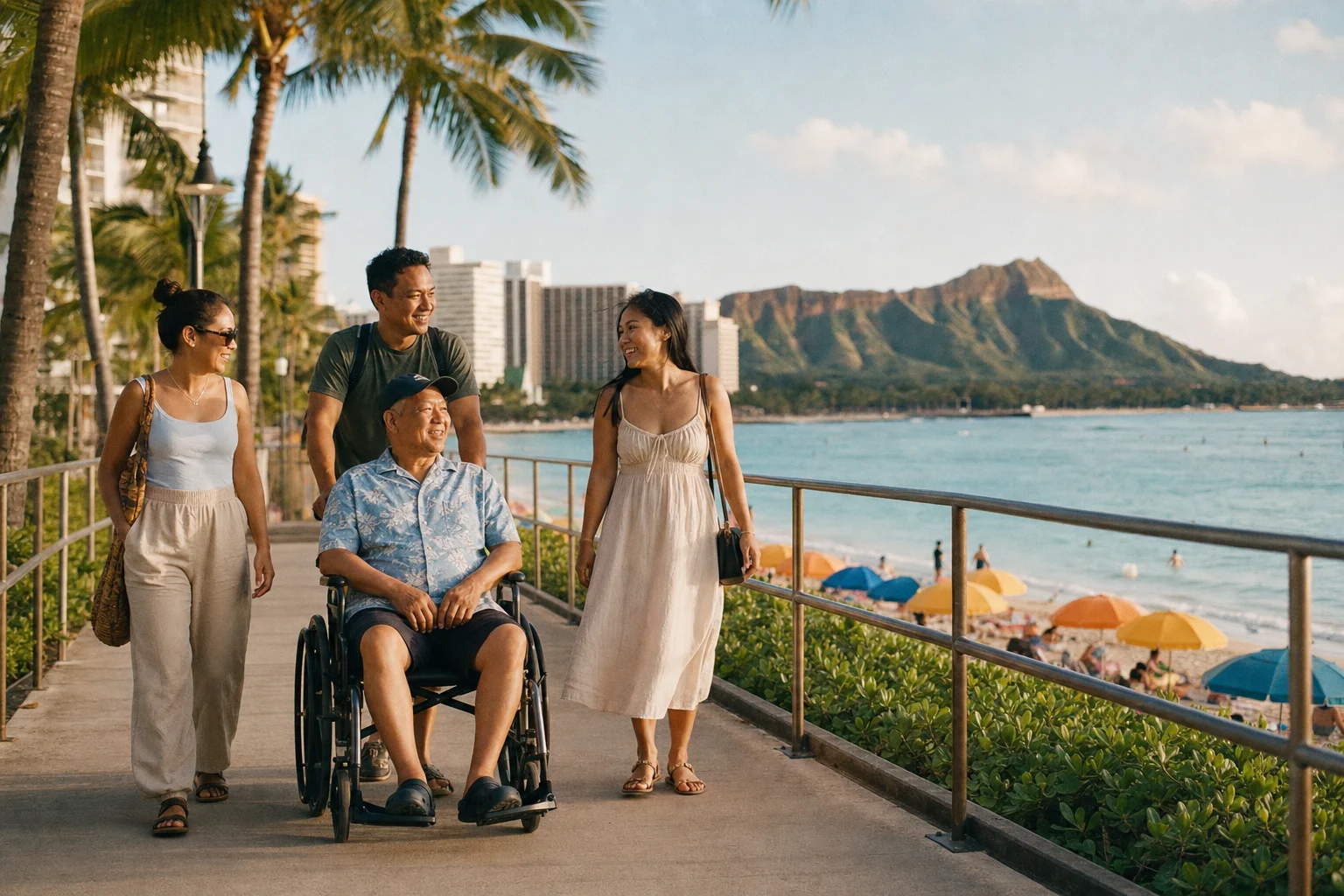
Most accessible travel guides treat beach destinations as inherently difficult - sand, stairs, and steep paths - and leave it at that. Oahu is different enough from that assumption to be worth examining closely.
Waikiki’s main strip received over $100 million in sidewalk reconstruction. The city runs a free beach wheelchair lending program across seven beaches. TheBus - the public transit system that covers the whole island - is fully ADA-compliant, with low-floor buses, ramps, and priority securement. The major resorts have pool lifts. Ko Olina’s four lagoons connect via 1.5 miles of paved path with ramps to each shoreline. This isn’t a destination stretching to claim accessibility points - the infrastructure is genuinely good.
The gaps that remain are specific: sand stops at the water’s edge (getting into the ocean takes a companion and a transfer), one of the most-cited beaches on the island has had its city wheelchair out of service since August 2025, and tour buses with lifts require a confirmation call the day before or they show up without one. Know these three things going in, and Oahu becomes one of the more roll-friendly tropical destinations in the US.
The beach problem - and how Oahu handles it
Sand and wheels don’t coexist. That’s the fundamental tension on any beach island, and no amount of infrastructure fully resolves it. What Oahu does better than most is manage the distance between pavement and water.
The city’s mobi-mat network covers seven beaches: ʻEhukai, Haleʻiwa Aliʻi, Hūnānaniho, Kaimana, Kūhiō (Waikīkī), Waimānalo, and Waimea Bay. These rubberized paths run from the paved access point toward the waterline - far enough to make beach sitting practical, not far enough to reach the surf. The beach wheelchair program goes further. At Ala Moana, Fort DeRussy, Sans Souci, Hanauma Bay, Kualoa, and Pokaʻī, the city’s all-terrain chairs (rated to 300 lbs) cover the gap between the mat and the water’s edge, with an attendant. Reserve at least a day ahead through the City and County of Honolulu’s Department of Parks and Recreation.
Getting into the ocean from a beach wheelchair at most of these locations still requires a water transfer with a companion - the chair gets you close, a person helps you the rest of the way. Aulani’s beach wheelchair at Ko Olina is the exception; it’s rated for water entry.
One flag: Kailua Beach Park’s city wheelchair has been out of service since August 2025, which matters because Kailua is frequently cited as Oahu’s most beautiful beach and most travel sites haven’t updated to reflect the gap. The mobi-mats at Kailua remain in place, so you can get to the sand - but for water-edge access, rent a beach wheelchair through UGo Mobility or Oahu Mobility Scooters, who deliver to the site.
For the most complete beach experience without worrying about any of this: Hanauma Bay. The city’s free tram runs every ten minutes from the parking lot down to the beach on a steep grade that would otherwise be a barrier, the tram is ramp-equipped, and a beach wheelchair is available at the Beach Information Kiosk from 8am to 3pm year-round. The mandatory orientation video has closed captions in seven languages. Go Wednesday through Sunday (the bay is closed Mondays and Tuesdays) and book timed entry online.

The city beach wheelchair program, mobi-mat coverage, and resort beach chair availability all have different booking requirements and current status. Mira can pull the current picture for the specific beaches you’re planning and flag anything that needs a verification call before you go.
AI travel agent
Waikiki as a base
Waikiki’s practical advantage is density. Multiple miles of flat, ADA-standard sidewalk along Kalakaua Avenue connect hotels to beaches to restaurants without a car. The beachfront promenade has paved access paths running parallel to the water, mobi-mats at Kūhiō Beach Park, and the city wheelchair available at Fort DeRussy Beach, which sits at the western edge of the Waikiki strip. TheBus Routes 2, 13, and 42 serve Waikiki and major attractions island-wide - low-floor buses with ramps, priority seating, and stop announcements.
Restaurant access on Kalakaua is generally reliable for outdoor terrace dining. For indoor restaurants on side streets, check before walking there - some have a step or raised threshold at the door even when the interior is level. Hula Grill Waikiki, House Without a Key at Halekulani, and RumFire at Sheraton Waikiki are specifically documented as accessible with oceanfront or open-air seating.
The beach side of Waikiki is where Fort DeRussy Beach earns its place. It sits directly across from the Hilton Hawaiian Village and is one of the few Waikiki beaches with a combination of paved access, mobi-mats, and the city’s free beach wheelchair.
Where to stay
Aulani, A Disney Resort and Spa
Aulani at Ko Olina is the most carefully designed accessible resort on the island. Every pool - including the lazy river at Waikolohe Valley - has an ADA-compliant pool lift. The Waikolohe Valley pool itself has zero-depth entry with a water wheelchair available for in-pool use. Roll-in showers come with pull-under sinks. The beds are engineered at transfer height with clearance underneath for a Hoyer lift - a design detail that almost no US resort documents publicly, and one that signals the design team actually consulted people who use them.
The resort’s paved beachfront path runs nearly 2 miles. All restaurants are step-free. Laniwai Spa has no access barriers. Character dining, luau seating, and the spa are all reachable from the path without a threshold or step.
The tradeoff is real: Aulani is 40 minutes west of Waikiki’s concentration of restaurants and non-resort attractions, and its pricing sits at the premium end of the island. It works best for families who plan to spend most of their time at the resort.
Hilton Hawaiian Village
Hilton Hawaiian Village covers 21 acres in Waikiki - directly walkable to Kalakaua Avenue’s dining strip, Fort DeRussy Beach, and the City’s beach wheelchair program. The Super Pool has zero-entry ramp access. Pool lifts at the Paradise Pool and Aliʻi Tower Pool round out the coverage. Duke Kahanamoku Lagoon has a paved perimeter with gentle water entry. Accessible rooms with roll-in showers are available across the Tapa, Aliʻi, and Rainbow Towers.
The functional challenge at Hilton Hawaiian Village is its own size. Rainbow Tower houses over 1,000 rooms across five elevators - wait times stretch toward ten minutes during busy checkout and check-in windows. If you need quick elevator access regularly, request a room in a block closer to the pool core at booking. A powered mobility scooter makes campus navigation substantially easier on a property of this scale.
Turtle Bay Resort (Ritz-Carlton O’ahu)
Turtle Bay on the North Shore offers 16 accessible room configurations, including an ocean bungalow with an ADA bathroom that guest reviews call unusually spacious. Hydraulic pool lifts at all pools, beach wheelchair on-site, and 14 accessible parking stalls near the main entrance. The campus is spread out and quiet - a different pace from Waikiki.
The distance is the trade: Turtle Bay is 45-plus minutes from Waikiki and most island attractions. Accessible rooms sell down quickly; forum accounts report only four ADA rooms available four months out on peak dates. Book six months ahead if this is your property.
Wayfinder Waikiki
Wayfinder Waikiki sits at the value end of the Waikiki market and publishes specific measurements on its accessibility page - one of the few affordable properties to do so. The ADA room has a documented 32-inch doorway clearance, a roll-in shower with shower chair, and a pool chair lift. Toilet seat height 17–19 inches, sink knee clearance 30 × 27 × 17 inches. The registration desk is 45¾ inches high with document pass-through space. For families who need to verify measurements before booking, this is the one Waikiki budget option with the data.
A note on vacation rentals: multi-story condos without elevators make up a significant portion of Hawaii’s private rental market. An Airbnb listing marked “accessible” has no verification standard behind it. Hotels and resorts are legally required to meet ADA room specifications and list accessible inventory accurately on booking platforms. Private rentals are not.
Roll-in shower availability, pool lift confirmation, and Hoyer-lift bed clearance are the three questions that most booking pages answer vaguely. Mira can work through your specific room requirements against what each property has actually documented, and flag which ones need a direct call before arrival.
AI travel agent
Excursions that work
Pearl Harbor
Pearl Harbor is almost entirely navigable. The Visitor Center, galleries, theater, and the Navy ferry to the USS Arizona Memorial are all step-free. The memorial itself is flat. USS Missouri’s main deck is accessible via ramp and has an elevator. Pearl Harbor Aviation Museum is step-free throughout. The USS Bowfin submarine interior is the exception - the hatches and ladder make it physically inaccessible - but the Bowfin museum adjacent to it is not.
Book on recreation.gov and arrive at least an hour before your tour time.
Polynesian Cultural Center
All village areas at the Polynesian Cultural Center are paved and step-free. The HĀ: Breath of Life theater has a dedicated wheelchair row positioned between the lower and upper seating levels - it’s the only step-free position in the venue. Canoe tours require that non-motorized chairs be folded and stored onboard while guests sit independently in the canoe; motorized scooters travel separately and meet riders at the opposite landing. Mobility scooter rentals are available on-site through Hawaii Scooters for day visitors who want powered access to the full campus.
Blue Hawaiian Helicopters
Blue Hawaiian uses an ableSling transfer system and a chair lift to board wheelchair users, with large-window back-row seating. A wheelchair user with Spinal Muscular Atrophy described it as “hands-down one of my favorite experiences of all time” and “being moved to tears by the beauty of the island.” The aerial view of the Na Pali coastline, Ko Olina, and the volcanic crater is something you can’t get any other way from a wheelchair - the experience is exceptional on its own terms, and the trained crew makes the boarding process work.
Ko Olina Lagoons
Ko Olina’s four public lagoons are free to visit regardless of which resort you’re staying at. A 1.5-mile paved path connects all four, with paved ramps leading to each shoreline, accessible restrooms, and accessible parking at each lagoon. The water is calm and protected - the protected crescent shape makes it genuinely easier to get close to the water than on an open-ocean beach. Lagoon 4 (Ko Olina Beach Park) has accessible picnic areas.
One note: the paved ramp delivers you to the sand edge. Getting to the water from there still takes a beach wheelchair or a personal beach wheelchair rental - the city’s lending program doesn’t extend to Ko Olina. Aulani guests have access to the resort’s beach wheelchair on-site.
Getting around
TheBus covers the island with fully ADA-compliant low-floor buses and ramps on every vehicle. For families renting a wheelchair-accessible van, Wheelers Accessible Van Rentals operates in Honolulu with daily and weekly rates. Uber and Lyft WAVs exist but run thin during peak season - reliability isn’t guaranteed if you need a wheelchair-accessible vehicle on short notice.
Tour buses are where the single most consistent failure mode appears. Roberts Hawaii and Polynesian Adventure Tours both operate lift-equipped coaches, but multiple first-hand traveler accounts report non-lift buses arriving despite “accessible” confirmations at booking. The fix is straightforward: call the operator 24 hours before pickup and ask them to confirm a lift-equipped bus is assigned to your trip. Do not assume the booking confirmation does this for you.
Frequently Asked Questions
Which Oahu beaches have free beach wheelchair loans?
Is Waikiki navigable by wheelchair between hotels, restaurants, and beaches?
Can wheelchair users visit Pearl Harbor?
Do Oahu tour buses actually have wheelchair lifts?
What's the most roll-friendly resort on Oahu?
More articles about Oahu
Destination Guide
-

Oahu with Kids (2026): The Family Travel Planning Guide
Most families book Oahu thinking the hardest part is finding the right hotel - the hardest part is picking the right side of the island.
-

First Time in Oahu: What to Know Before You Land
The island punishes over-planning and under-booking in equal measure - here's how to thread it.
Who's Traveling
-
Oahu with a Large Family: What to Book and Where
The law changed in 2022. Most travel blogs didn't get the memo.
-

Oahu for Multi-Generational Families: A Real Guide
The island works across four generations - but only if you make one foundational choice before anything else.
-

Oahu with a Baby: What to Book and Where to Stay
The island is more manageable with an infant than you think - if you make one decision right before anything else.
-

Oahu with Grandparents: The Hotel Choice That Matters Most
The island itself is the easy part. The hotel is where most families get it wrong.
-

Oahu with School-Age Kids (Ages 6–14)
The families who love it most are the ones who slowed down.
-

Oahu with Teens: Leave Waikiki to Win
The resort pool is fine. The trip your teenagers will actually remember is an hour north.
-

Oahu with a Toddler: Two Decisions That Shape Everything
The island is more forgiving than you'd expect - if you make the right two calls before you land.
Sensory & Accessibility
-

Oahu Without the Sensory Wall of Waikiki
The island rewards early mornings, calm lagoons, and knowing which resort sits on the quiet side of the enclave.
-
Oahu Low-Stimulation Travel
The island has genuinely quiet places. The work is sequencing them so you reach them before the crowds do.
-
Quiet Hotels on Oahu: Where to Actually Sleep
The island isn't uniformly noisy - but you have to know which kind of quiet you're looking for.
-

Sensory-Friendly Oahu: Ko Olina vs. Waikiki
Ko Olina's lagoons were engineered for calm. Waikiki was not.
Food
-

Eating Safely on Oahu: A Family Allergy Guide
The island is workable - if you know where the traps are before you land.
-

Oahu with Food Allergies
The island's food is extraordinary - and it overlaps with nearly every major allergen in ways most guides miss entirely.
-

Oahu with Picky Eaters: A Practical Guide
The food culture is proudly local. Your kid doesn't have to be.
Room Setup
-

Connecting Rooms in Oahu: Who Actually Guarantees It
The difference between a guaranteed connection and a front-desk argument at 11pm is knowing which hotels have actually solved this.
-

Family Suites in Waikiki and Ko Olina: What's Real
The word "suite" means something different in every Waikiki brochure. Here's what's actually behind the door.
-

Oahu Condos with Kitchens: What to Actually Book
The most consequential decision you'll make for this trip isn't the beach - it's the cooking setup.
On-Site Activities
-

Oahu Kids Clubs: Which Resort Actually Delivers
The best supervised drop-off programs on the island are free - but not where most families are staying.
-

Oahu Hotels with a Lazy River: One Resort, One River
There's exactly one hotel on the island that has one - and a few things you need to know before you book it.
-

Oahu Water Parks: Aulani, Wet 'n' Wild & More
One real park, one Disney complex that rivals it, and a Waikiki hotel that most families drive past without realizing it has a waterslide.
Powered by Mira
Tell Mira about your family
Two minutes of conversation. A shortlist of hotels that actually fit — connecting rooms, accessible layouts, calm floors, whatever your family needs.
AI travel agent · free to try
Talk to Mira Let Mira find the right hotels for your family. Find hotels with Mira
AI travel agent · free to try