
Hawaii
Oahu with Food Allergies
The island's food is extraordinary - and it overlaps with nearly every major allergen in ways most guides miss entirely.
AI travel agent · free to try
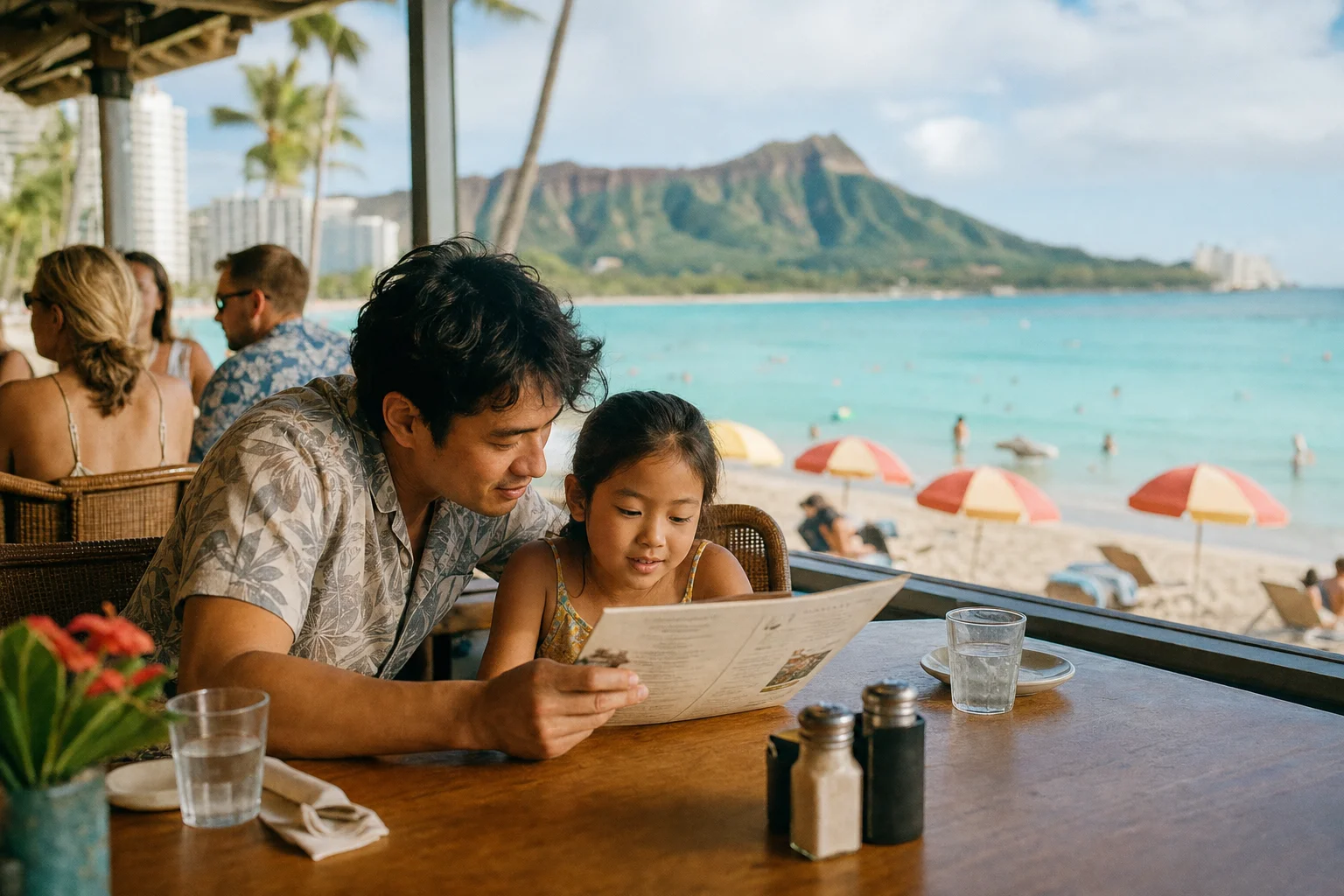
Oahu’s food is built on soy sauce. It’s in the poke marinade, the teriyaki glaze on every plate lunch, the dipping sauce that comes automatically with dim sum at the neighborhood diner. Locals call it shoyu, and standard shoyu contains wheat - which means a soy allergy and a wheat allergy both walk straight into the same invisible wall on day one. Saimin, the local noodle soup that shows up on menus the way ramen does in Japan, typically runs on shrimp-based broth. Haupia - the coconut pudding that closes out every luau and sits in hotel buffet dessert sections - is classified as a tree nut product under FDA allergen labeling rules. Macadamia-crusted fish is on nearly every resort dinner menu, and unless a kitchen explicitly confirms fryer separation, those mac nuts share oil with the french fries.
None of this means Oahu is impossible. It means the defaults are not on your side, and the families who do this well know exactly what they’re walking into before they land.
The honest allergen landscape
The nine major allergens - milk, eggs, fish, shellfish, tree nuts, peanuts, wheat, soy, sesame - all have a natural home in Hawaiian cuisine. Every course of a typical luau contains at least one. Sesame oil and seeds are standard in poke marinades and seaweed salads. Spicy poke varieties use spicy mayo, which is egg-based. Shrimp appears in saimin broth, in poke cases sharing refrigerated space with ahi and salmon, in resort buffets where serving spoons travel between dishes. And haupia is everywhere: if someone in your family reacts to coconut and manages tree nut allergies, the local dessert landscape just got much smaller.
Hawaii’s 2025 food safety code updates require restaurants to inform diners when any of the nine major allergens are present - through menus, signage, or table handouts. That’s an improvement. But disclosure of presence is not the same as cross-contact prevention, and a resolution passed by the Hawaii legislature in 2024 (HR113) urging restaurants to make full ingredient lists available on request is exactly that - a resolution urging, not a binding law. Families who arrive expecting the same mandatory transparency they’d find in, say, a UK restaurant are operating on a legal assumption that doesn’t hold.
The practical implication: in Oahu, verification is your job. The burden doesn’t shift to the restaurant by default.

If you’re still figuring out whether Aulani or a Waikiki hotel makes more sense given your family’s specific allergen profile, Mira can help you work through the options - the right base matters more than most guides acknowledge.
AI travel agent
Where the certainty lives: Aulani
Aulani, A Disney Resort & Spa at Ko Olina, runs the most structured allergy system on the island. At both table-service restaurants - Makahiki and ‘Ama’Ama - allergies are flagged at the time of reservation. At arrival, the reservation receives an ALLERGY stamp; the kitchen uses pink allergy tickets and dedicated notepads; servers recite the dish name and full allergy list aloud before placing any food on the table. Chef consultations are available at all dining locations. Families have reported the same chef following them across multiple meals across multiple days during a stay - not standard hospitality, a Disney operations feature.
The limits are real and worth stating. Aulani has no dedicated allergen-free kitchen - cross-contact cannot be guaranteed. Quick-service locations and the resort luau are significantly less equipped for complex multi-allergen cases. One reviewer managing tree nuts, peanuts, potato, wheat, sorghum, and dairy found that only the two table-service restaurants could safely accommodate her family.
The room setup matters here almost as much as the restaurant system. Studio rooms come with a microwave and refrigerator; villa rooms have full kitchens with ranges. Rice cookers are available on request. Within five minutes of the resort in Kapolei: Costco, Walmart, Target, and Down to Earth natural food store - all in the same commercial corridor. Families with the most complex allergen profiles use this deliberately, self-catering breakfast and snacks, then managing one carefully handled dinner at Makahiki or ‘Ama’Ama.
Four restaurants with documented protocols
Duke’s Waikiki
Duke’s protocol puts a manager in the loop every time an allergy is disclosed. Servers escalate; the manager personally delivers allergy-flagged plates. The kitchen works with all nine major allergens - this isn’t a dedicated allergen kitchen - but the chain of custody between your table and the food is better-documented than the average Waikiki restaurant. Multiple allergy community reports confirm custom meal preparation after manager consultation. Not suitable for airborne-sensitive or contact-reactive cases; a viable option for moderate shellfish or tree nut allergies with good communication.
Monkeypod Kitchen
Both the Waikiki location (at Outrigger Reef) and the Ko Olina location have documented fryer separation: no peanut oil, mac nuts not fried. That’s a meaningful specific for tree-nut-allergic families eating on an island where macadamia-crusted fish comes standard on almost every resort menu. Reviewers with severe nut allergies have successfully navigated both locations with staff support. Server knowledge is inconsistent - escalate to a manager or kitchen lead rather than relying on whoever seats you.
Pu’uwai Aloha Bakery
The only identified dedicated gluten-free facility on Oahu. One kitchen, no shared equipment with wheat-containing products - a genuine safe harbor for celiac travelers who want a pastry without interrogating the kitchen. Most breads are also vegan; extensive dairy-free options. The limitation: hours run Thursday through Sunday, 8am to 2pm, at 918 Smith St in Honolulu. For resort-area families, it works best as a planned detour rather than a daily option.
Peace Cafe
100% vegan premises, which structurally eliminates shellfish, fish, dairy, and eggs from the environment. Staff are frequently cited as knowledgeable and genuinely welcoming. The restaurant is explicit, though, that all food is prepared in a shared kitchen and they are not responsible for secondary reactions in guests with cross-contact sensitivity. Nuts appear in some dishes. The “vegan kitchen = safe” shortcut doesn’t hold here for multi-allergen families managing nuts. Best for mild-to-moderate dairy, egg, and fish allergies where the shared-nut situation is tolerable.
If you want a tighter list of which restaurants to actually book given your specific allergens - not just the general Oahu guide - Mira can help you narrow it down before you arrive.
AI travel agent
Poke, shave ice, and luaus - doing the local food
Poke: Most poke counters store ahi, salmon, shrimp, crab, and octopus in the same refrigerated display case with shared scoops. Sesame oil and seeds are in nearly every marinade. Spicy mayo is egg-based. For shellfish-allergic families, ask for a bowl prepared fresh from unwrapped product in the back, name the allergy specifically, and confirm no shared equipment. Nico’s Pier 38 - a fish market counter in Honolulu - is the most consistently cited transparent poke counter for allergen questions. Many families with shellfish allergies skip poke shops entirely and order fresh fish at sit-down restaurants where kitchen separation is easier to verify.
Shave ice: The flavored syrups at major shops are generally nut-free. Everything beneath and above the ice is where the risk is: ice cream scoops at Matsumoto Shave Ice in Haleiwa are manufactured in a facility using tree nuts, eggs, milk, soy, and whey. At Waiola in Honolulu, allergy-community reports consistently note a nut-free menu and staff who understand the fresh-scoop protocol. The plain order - shave ice with syrups, no ice cream base, no condensed milk drizzle, no mochi, no azuki beans - is the low-risk version at almost any shop. Banan Waikiki Beach Shack is plant-based, dairy-free, and gluten-free soft serve with no nuts on the core menu, which makes it the single lowest-risk frozen treat option in the Waikiki footprint.
Luaus: Chief’s Luau, in the Ko Olina area, posts allergen cards at each food station - with notation on nut status per dish. That’s a higher documentation standard than most Oahu luaus. The rule across all luaus: call the kitchen directly, not the booking desk. Ask for a culinary lead or chef and document the conversation. Booking agents cannot relay allergy needs to kitchen staff; the cooking team controls what substitutions are possible.
The self-catering strategy
Down to Earth - a vegetarian grocery chain with locations in Honolulu, Kailua, Kapolei, and Pearlridge - has a deli counter that allergy-community members consistently cite as reaction-free. One Tripadvisor forum member managing multiple food allergies wrote: “I have never had a reaction from their deli.” For Ko Olina and Aulani families, the Kapolei location is five minutes away.
KCC Farmers Market, running Saturdays at Kapiolani Community College, is the most ingredient-transparent food environment on the island - and the reason is simple: the person answering “what’s in it” is the person who made it. Li’ili’i Donuts sells vegan and egg-free donuts alongside its regular lineup, and Middle Eats runs a 100% vegan Middle Eastern counter where cross-contact with animal products isn’t a variable at all. A FARE blogger managing an egg allergy called it the best Oahu food experience she had - not because of the selection, but because she never had to explain herself twice. Arrive before 9am; popular stalls sell out.
Some allergy families plan an Oahu trip around this deliberately: one carefully managed restaurant dinner per day, self-catered everything else. It’s not a fallback. For genuinely complex multi-allergen profiles, it’s often the only approach that actually keeps the vacation low-stress.
What to know about blenders and buffets
Two cross-contact risks that don’t make it into most Oahu allergy guides:
Resort buffets have open displays, shared serving utensils, and shellfish, nut-containing desserts, and every other allergen sitting in proximity to one another. The specific failure point is the serving spoon that travels from shrimp scampi into chicken pasta before you get there. For any anaphylaxis-level shellfish or nut allergy, the conversation before the meal is with the chef on duty - not the server, not the host stand.
Blenders at Waikiki beach bars and smoothie counters are a shared-equipment risk almost no one thinks to flag. Protein shakes, nut-milk blends, and mixed drinks run through the same blender as plain fruit smoothies unless you ask for a dedicated wash. A Tripadvisor forum member documented a reaction at a beach bar after forgetting to mention a soy allergy to a bartender who’d just blended a protein shake in the same machine.
Emergency basics by location
For families staying in Waikiki: Straub Medical Center and Queen’s Medical Center’s main Honolulu campus are both within the city. Straub Doctors on Call at Sheraton Waikiki is urgent care - appropriate for minor reactions, not anaphylaxis.
For families at Ko Olina or Aulani: the nearest full emergency room is Queen’s Medical Center - West O’ahu on Fort Weaver Rd, roughly 15–20 minutes from Ko Olina depending on traffic. Know the route before you need it.
On EpiPens: allergy community veterans consistently recommend carrying at least two auto-injectors when traveling. The concern isn’t that Hawaii is uniquely dangerous - it’s that if you’re on a snorkeling boat, at a remote beach, or sitting in H-1 traffic, more time passes between first dose and a full ER than at home. One injector stays with the allergic person. Not in a beach bag. Not in the hotel room.
Frequently Asked Questions
Is Aulani the safest place to eat on Oahu with severe food allergies?
Can we eat poke with a shellfish allergy?
What's the safest frozen treat option in Waikiki for nut allergies?
Where is the nearest emergency room to Ko Olina and Aulani?
Does Hawaii law require restaurants to disclose allergens?
More articles about Oahu
Destination Guide
-

Oahu with Kids (2026): The Family Travel Planning Guide
Most families book Oahu thinking the hardest part is finding the right hotel - the hardest part is picking the right side of the island.
-

First Time in Oahu: What to Know Before You Land
The island punishes over-planning and under-booking in equal measure - here's how to thread it.
Who's Traveling
-

Oahu with a Large Family: What to Book and Where
The law changed in 2022. Most travel blogs didn't get the memo.
-

Oahu for Multi-Generational Families: A Real Guide
The island works across four generations - but only if you make one foundational choice before anything else.
-

Oahu with a Baby: What to Book and Where to Stay
The island is more manageable with an infant than you think - if you make one decision right before anything else.
-

Oahu with Grandparents: The Hotel Choice That Matters Most
The island itself is the easy part. The hotel is where most families get it wrong.
-

Oahu with School-Age Kids (Ages 6–14)
The families who love it most are the ones who slowed down.
-

Oahu with Teens: Leave Waikiki to Win
The resort pool is fine. The trip your teenagers will actually remember is an hour north.
-

Oahu with a Toddler: Two Decisions That Shape Everything
The island is more forgiving than you'd expect - if you make the right two calls before you land.
Sensory & Accessibility
-

Oahu Without the Sensory Wall of Waikiki
The island rewards early mornings, calm lagoons, and knowing which resort sits on the quiet side of the enclave.
-

Oahu Low-Stimulation Travel
The island has genuinely quiet places. The work is sequencing them so you reach them before the crowds do.
-

Quiet Hotels on Oahu: Where to Actually Sleep
The island isn't uniformly noisy - but you have to know which kind of quiet you're looking for.
-

Sensory-Friendly Oahu: Ko Olina vs. Waikiki
Ko Olina's lagoons were engineered for calm. Waikiki was not.
-

Wheelchair-Accessible Oahu: What's Actually Possible
The infrastructure is genuinely impressive. The gaps are specific - and you can plan around them.
Food


Room Setup
-

Connecting Rooms in Oahu: Who Actually Guarantees It
The difference between a guaranteed connection and a front-desk argument at 11pm is knowing which hotels have actually solved this.
-

Family Suites in Waikiki and Ko Olina: What's Real
The word "suite" means something different in every Waikiki brochure. Here's what's actually behind the door.
-

Oahu Condos with Kitchens: What to Actually Book
The most consequential decision you'll make for this trip isn't the beach - it's the cooking setup.
On-Site Activities
-

Oahu Kids Clubs: Which Resort Actually Delivers
The best supervised drop-off programs on the island are free - but not where most families are staying.
-

Oahu Hotels with a Lazy River: One Resort, One River
There's exactly one hotel on the island that has one - and a few things you need to know before you book it.
-

Oahu Water Parks: Aulani, Wet 'n' Wild & More
One real park, one Disney complex that rivals it, and a Waikiki hotel that most families drive past without realizing it has a waterslide.
Powered by Mira
Tell Mira about your family
Two minutes of conversation. A shortlist of hotels that actually fit — connecting rooms, accessible layouts, calm floors, whatever your family needs.
AI travel agent · free to try
Talk to Mira Let Mira find the right hotels for your family. Find hotels with Mira
AI travel agent · free to try