
Mexico Caribbean
Riviera Maya with School-Age Kids
The cenotes, ruins, and eco-parks were all built for exactly this age window.
AI travel agent · free to try
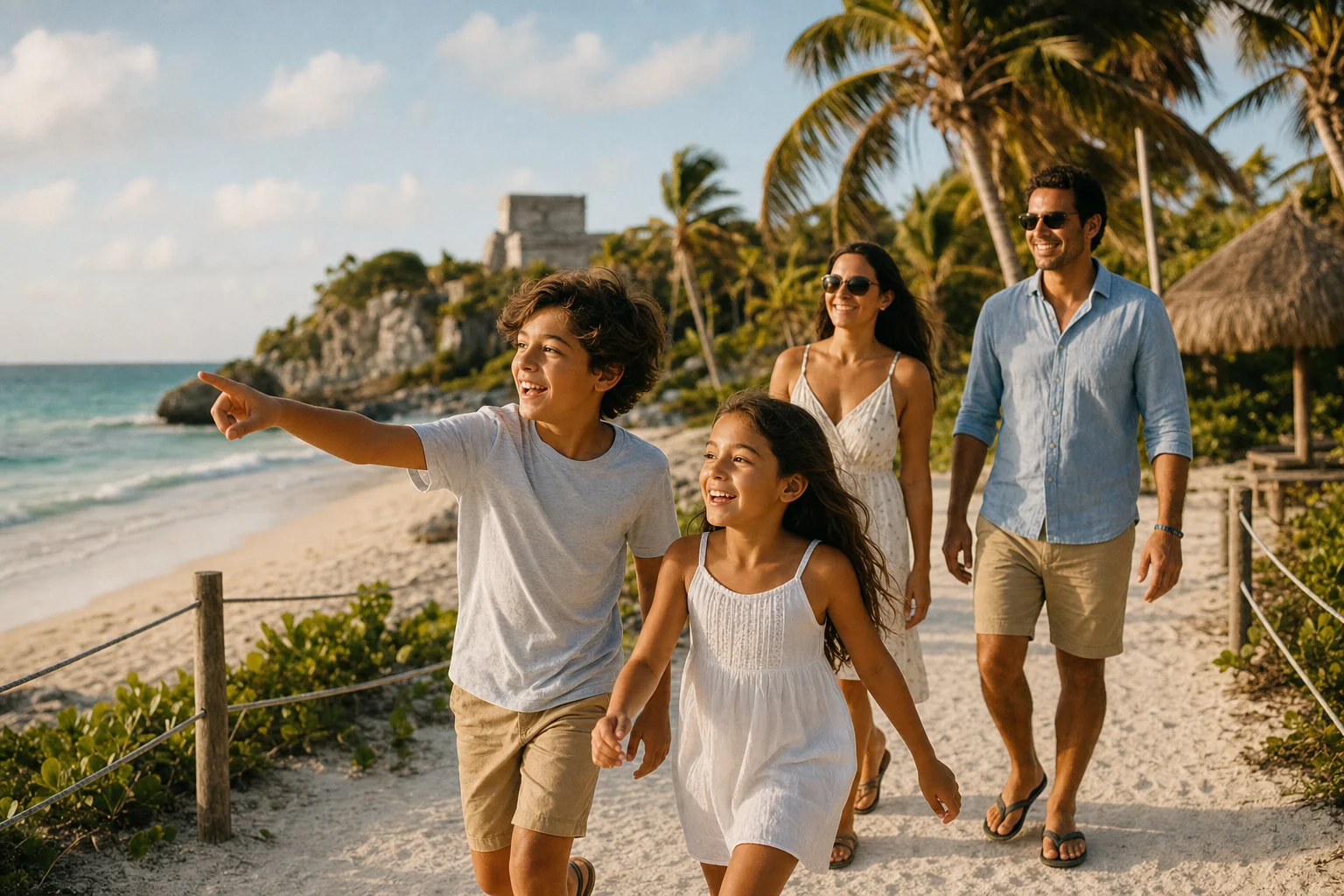
Most of the Riviera Maya’s genuinely memorable activities have age and size floors that quietly exclude the under-6 crowd entirely: cenote snorkeling requires a child who can follow instructions and hold a mask seal, Coba’s pyramid climb requires a kid who won’t freeze at the top, and Xcaret’s Children’s World and zip parks reward the cohort that craves stimulation over a nap schedule. The all-inclusive pitch works fine for toddler years. This destination actually earns its reputation with the 8-12 set, and pays real dividends for kids as young as 6 if you build the itinerary around their age window rather than around what the resort website photographs.
The parents who come home from a good Riviera Maya trip with school-age kids almost always did one thing: they planned one or two off-resort days. The difference between a comfortable vacation and a trip the kids remember for years lives in whether you made it to a cenote, a ruin, or both.
Why school-age specifically changes what’s possible here
A 6-year-old can snorkel Cenote Azul with a life vest in 77-degree water with no current and wide limestone shelves they can stand on. A 10-year-old can climb the Coba pyramid with the new wooden staircase that replaced the original stone steps when the site reopened in December 2025. A 9-year-old at Xcaret can do the underground river swim and spend an hour in the Children’s World obstacle course. Kids 10 and up qualify for Discover Scuba Diving - a PADI resort introduction with no prior certification required, supervised confined-water session followed by a guided ocean dive.
None of these are available to a 3-year-old, and a teen who’s been through it before gets less from each. The 6-12 window is when all of it arrives at once.
Coba in particular is worth flagging because the setup changed substantially. The pyramid is now managed with timed entry in groups of roughly 15 and a 15-minute summit limit. It’s more structured than it was before the 2024 closure, which adds a queue, but the wooden staircase makes the descent genuinely safer for kids who might have hesitated on stone. It’s currently the only major Yucatan pyramid still open for climbing. Book timed entry in advance; peak-season queues haven’t been fully documented yet but early reports suggest arriving early matters as much as it always did.
Hotels worth thinking about
The kids-club quality trap is the single biggest booking risk on a school-age trip to Riviera Maya. Star rating and nightly price are both poor proxies for club quality. Some of the priciest resorts run wellness-adjacent programming that leaves activity-hungry kids asking to leave by hour two - one parent put it plainly in a review: their kids wanted to run around and play; the club was running meditation-style sessions they had zero interest in. Some mid-tier resorts run exceptional, activity-driven programs.
Before booking anything with a kids club as a selling point, call the resort and ask for the current weekly activity schedule - the actual printed schedule for your travel dates, which may look nothing like the marketing photos. One parent who did exactly this discovered that the club ran half-days only on two of the three days during their stay. The calls take 10 minutes and save real heartbreak.
Grand Velas Riviera Maya
Grand Velas runs two kids clubs on-property - one in the Ambassador section, one in Zen - with hours that stretch to 11pm, which matters for families who want an adults-only dinner that goes past 8. The programming is genuinely activity-led: piñata making, cooking classes, ceramics, alebrijes craft workshops, foam parties, a rock wall, and trampolines. The Teens’ Club (ages 13-18) has PS5 consoles, karaoke, sports simulators, and a VIP movie theater, which means families with older kids who’ve aged out of standard club programming still have somewhere to send them. One real caveat that appears consistently in reviews: the Su Casa signature restaurant has drawn complaints about 90-minute waits for a light lunch.
Hard Rock Hotel Riviera Maya
The property divides into Hacienda Rojo (family-oriented, livelier) and Hacienda Azul (quieter, still family-accessible); the Heaven section is adults-only. For school-age kids, the combination of Roxity Kids Club (ages 4-12), Rockaway Bay Water Park on-site with a wave pool, lazy river, and slides, plus an e-sports arena, escape room, bowling alley, and laser tag means there are genuine options on rain days or days when the beach is sargassum-covered and you need something else. The beach is lagoon-style and sheltered, which makes it meaningfully calmer for less-confident swimmers.
Fairmont Mayakoba
Fairmont Mayakoba sits on 240 acres of tropical forest with crystal-clear waterways, about 40 minutes south of Cancun. The Balam Kids Club runs a curriculum-based program (ages 5-11) with 3 free hours daily. What distinguishes this resort from the megaplex all-inclusives is the setting itself - kids are often as absorbed by the wildlife visible from the canals (herons, coatis, iguanas appearing at close range) as by any organized activity. The pick for families who want upscale atmosphere and genuine nature rather than a theme-park-style resort experience.
Generations Riviera Maya by Karisma
Every room is a suite with a separate bedroom and living area, starting at 722 square feet, scaling up to 2- and 3-bedroom configurations for families of 5 or more. The Little Eko Chefs cooking program is a consistent hit with school-age kids who have any interest in food. Honest caveats from reviews: the food at the restaurant level is mediocre by luxury standards, and the beach is small and rocky. The pick when room size and kitchen-style living space are the priority and you’re planning enough off-resort excursion days that beach quality is secondary.
Nickelodeon Hotels and Resorts Riviera Maya
Aqua Nick water park, 20 slides, two lazy rivers, character meets with SpongeBob, PAW Patrol, and TMNT - strong for the 6-10 range who still connect with the IP. The caveats are worth knowing before you book: multiple reviews cite a beach area with minimal sand before a steep drop-off with cement blocks in the water, and the physical layout means a non-walkable distance from room blocks to the water park. Best if water park access and character experiences are the explicit priority and you’ve accepted that the beach won’t be the main draw.

Mira can match your kids’ ages, the club activities that actually matter to them, and whether your dates overlap with sargassum season to point you toward the right property - including ones where the beach contingency plan is already built in.
AI travel agent
Off-resort days worth building around
Cenotes
Cenote Azul near Playa del Carmen has natural limestone shelves and wide shallow sections where younger school-age kids can stand, with deeper areas for stronger swimmers - one of the most accessible family cenotes in the region, and the sheltered entry makes it a reasonable first cenote for a 6-year-old. Gran Cenote near Tulum has resident turtles in the snorkeling zone and pairs naturally with the Tulum ruins 5 minutes away, making it a ready-made half-day: ruins first, cenote after.
A few things that matter more than most guides say: bring child-sized snorkel gear from home. Rental gear is sized for adults and fits kids poorly enough to make the snorkeling miserable. Biodegradable sunscreen is mandatory at every cenote - rangers will send you back to the entrance to buy it if you show up with a regular bottle.
Akumal turtle snorkeling
Akumal Bay is a natural seagrass feeding ground for green sea turtles, and at 8-11am when the turtles are actively feeding, sightings are consistent for most visitors. The bay is calm enough for school-age kids. Critical rules: 10 feet minimum distance from turtles, no touching, no standing on seagrass. The access system at Akumal has become more regulated in recent years - entry and guide requirements have changed from the informal wade-in experience of earlier visits, so check the current setup before assuming it works the same way it did in 2019.
Xcaret vs. Xel-Ha
For kids 6-9, start with Xel-Ha. It’s fully all-inclusive - one price covers unlimited food, drink, and activities - the water is calmer, and the snorkeling in the natural lagoon and inlet is genuinely good without requiring much skill. It’s also physically less exhausting than Xcaret, which matters if you’re mid-trip and your kids have already done two excursion days.
Xcaret earns its place for kids 9-12 who have the stamina for a full day: the Children’s World zone, the underground river swim, the cultural performances, and the breadth of the eco-park make it richer than Xel-Ha, but the day runs long and food is not included in the base admission. Budget the additional food cost or pack lunch.
Ruins
Tulum is the right introduction for younger school-age kids - the site is compact, a 60-90 minute visit is realistic, and the cliffside ocean views make it visually striking enough that kids who’d tune out at a longer site stay engaged. Getting there has become more complicated than it used to be: the Tulum corridor is significantly more congested post-2023, so plan the logistics around 2024+ conditions rather than older blog advice.
Chichen Itza is worth the day if your kids have covered Mayan civilization in school - the ruins land differently when kids have classroom context for what they’re looking at. Go knowing it’s a full day: 2.5-3 hours each way from most Riviera Maya resorts, which makes it a 11-12 hour commitment in heat. Get there by 7:45am at the latest. One parent who arrived at 9am: “it was already an oven with crowds 10 deep at every structure. Our kids were done in 30 minutes - the heat just won.” Pack an unreasonable amount of water, plan a cenote swim on the return leg, and brief the kids in advance on what they’re there to see.
Tell Mira your kids’ ages and whether you’re more interested in nature days or ruins days - she can sketch which excursion sequence makes sense for your trip length and what to pair them with.
AI travel agent
The sargassum reality check
The 2026 forecast from the University of South Florida Oceanography Lab projects a potentially record or near-record year, with sargassum confirmed along Quintana Roo beaches in January and March ahead of historical averages. Peak accumulation runs May through August. East-facing beaches (Playa del Carmen, Akumal, Tulum) typically get the heaviest deposits; lagoon-style beaches like the Hard Rock’s are more sheltered by their geography.
This doesn’t have to ruin a trip if you plan around it rather than hoping against it. The mitigation is straightforward: book in November through February to largely miss it, or build cenote days and inland excursions into the itinerary as planned activities rather than backup options. A family that arrives expecting two cenote days and two beach days handles a sargassum-covered beach morning in stride; a family that planned five straight beach days has a harder week.
One health note worth knowing: decomposing sargassum releases hydrogen sulfide gas that can irritate eyes and respiratory systems. Keep kids away from large decomposing piles, and rinse them off with fresh water after any beach swim during sargassum season.
Before you go
When to travel: November through February is the clear sweet spot - dry season, minimal sargassum, post-hurricane season, manageable crowds. Late April and May also work well: spring break has cleared, summer families haven’t arrived, rates are lower, and sargassum is still minimal. Avoid mid-March through early April for spring break crowds; avoid June through October for hurricane season combined with sargassum peak.
What to pack: Biodegradable sunscreen for cenotes (regular sunscreen is confiscated at the gate). Child-sized snorkel gear. Oral rehydration sachets - dehydration hits kids faster than adults, and stomach illness can happen even at all-inclusives. Pesos for anything outside the resort: local vendors, taco stands, and most non-resort businesses don’t take USD or cards.
At ruins: Build early arrivals into your schedule without treating them as optional. At Coba, the timed entry system means the queue builds as the day progresses. At Chichen Itza, the early-arrival window is the difference between a functional visit and a heat-and-crowd disaster.
One category of activity families sometimes book without realizing what it is: “lion cub photos” and similar wildlife encounters are common offerings in Tulum and Playa del Carmen and are presented as legitimate family activities. They are widely reported as animal abuse operations. Skip them.
Frequently Asked Questions
Can kids still climb the pyramid at Coba?
Which eco-park is better for school-age kids - Xcaret or Xel-Ha?
Can my child snorkel at a cenote?
How bad is sargassum, really?
Can my 7-year-old do the zip-lines at Xplor?
What resorts have the best kids clubs for school-age kids?
More articles about Riviera Maya
Destination Guide
-

Riviera Maya Family Vacation Guide (2026)
Most families pick the resort and learn the base town matters more - and they pick a beach week without checking which months the beach actually exists.
-

Riviera Maya for First-Time Visitors
Nearly 100 miles of coast - the base you pick changes everything about what your trip becomes.
Who's Traveling
-

Riviera Maya for Large Families: Rooms That Actually Connect
The difference between a connecting room guarantee and a connecting room request - and which resorts have actually built the first one.
-

Multi-Generational Riviera Maya: What Actually Works
The all-inclusive format removes the per-meal friction - but the wrong resort turns a reunion into a scheduling problem before day two.
-

Riviera Maya with Grandparents: Resorts That Work
The all-inclusive format removes the logistics burden - but the wrong resort turns into an endurance test before lunch.
-

Riviera Maya with a Baby
The trip works when you book one of the five resorts that actually built for it.
-

Riviera Maya with Teens
The resort question that matters most, the excursion layer that makes the trip, and the things nobody tells you until it's too late.
-

Riviera Maya with a Toddler
The resort you pick determines whether you get a trip or a survival exercise.
Sensory & Accessibility
-

Sensory-Friendly Riviera Maya: What's Actually There
Two certified resorts, one visitor guide worth downloading, and the pre-arrival steps that determine whether any of it actually works.
-

Low-Stimulation Riviera Maya: Quiet Zones and Calm Days
The destination defaults to DJ pools and nightly fire shows. The quiet version is real - you just have to know which section to book.
-

Quiet Stays in Riviera Maya: What Actually Works
Most resorts say serene. A few actually are. Here's how to tell the difference before you book.
-

Sensory-Friendly Riviera Maya: What's Actually There
Three resorts have certification programs. The properties that actually work for low-stimulation families have no label at all.
-
Wheelchair-Accessible Riviera Maya: What to Book
The terrain works in your favor. The booking language does not.
Food
-

Dietary Accommodations at Riviera Maya Resorts
"We accommodate all dietary needs" means something very different depending on which resort said it.
-

Food Allergy Travel in Riviera Maya: What Works
Several resorts have documented allergy programs. The ones that hold at the plate are a shorter list.
-

Riviera Maya for Picky Eaters
The all-inclusive model lets your kid order, reject, and reorder without you doing math at the table.
Room Setup
-

Riviera Maya Connecting Rooms: Who Guarantees the Door
The difference between a resort that notes your request and one that actually holds the room.
-

Family Suites in Riviera Maya
The connecting-room guarantee is the thing to verify - everything else follows from there.
-
Riviera Maya Hotels with Kitchenettes for Families
The label "kitchenette" covers everything from a stocked fridge with free juice to a four-burner gourmet setup with a dishwasher. Ask first.
On-Site Activities
-

Riviera Maya Kids Clubs
The phrase "kids club included" covers everything from mangrove boat rides to a TV in a locked room. Here's how to tell the difference before you book.
-

Riviera Maya Resorts With a Lazy River
Not every "lazy river" in the brochure moves on its own - the gap between marketing and a real float is wider here than anywhere else in Mexico.
-

Riviera Maya with a Water Park
Some families want the water park at the hotel. Others want a day excursion to Xel-Ha. Confusing the two is how trips go sideways.
Powered by Mira
Tell Mira about your family
Two minutes of conversation. A shortlist of hotels that actually fit — connecting rooms, accessible layouts, calm floors, whatever your family needs.
AI travel agent · free to try
Talk to Mira Let Mira find the right hotels for your family. Find hotels with Mira
AI travel agent · free to try