
Mexico Caribbean
Riviera Maya for First-Time Visitors
Nearly 100 miles of coast - the base you pick changes everything about what your trip becomes.
AI travel agent · free to try
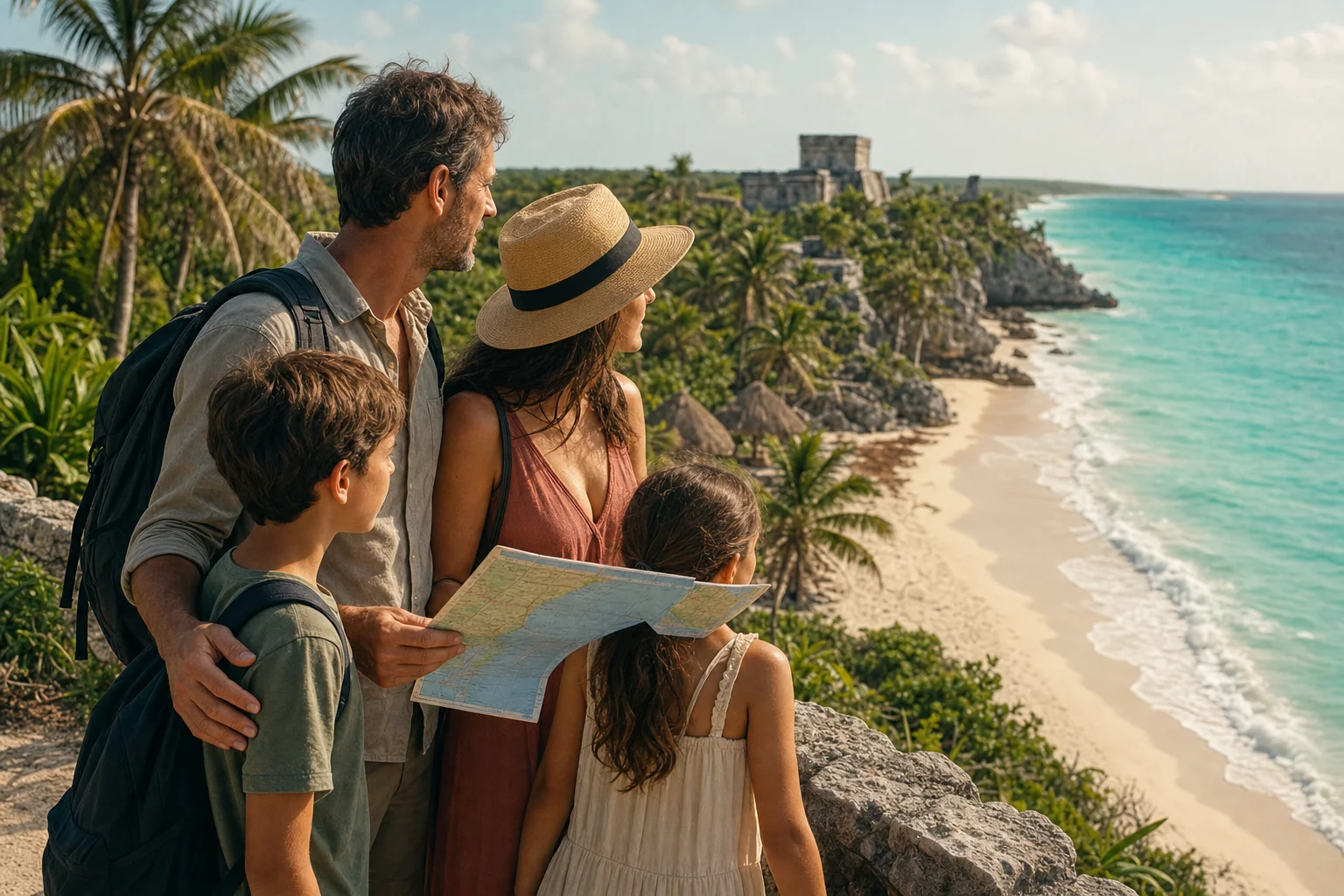
Most resort photos of the Riviera Maya look like the same beach: white sand, turquoise water, palm trees in the foreground. What they don’t show is that the “Riviera Maya” is nearly 100 miles of coast, that sargassum season now runs from May through October and 2026 is forecast to be a record year, and that the airport exit is staffed by uniformed people who are almost certainly not who they appear to be. None of this makes the region a bad choice for a first trip - it makes it a trip worth understanding before you land.
Where you stay changes everything
The most consequential decision on a Riviera Maya trip isn’t which excursion to book or which resort pool looks best in photos. It’s where along that 100-mile stretch you put your base.
The corridor runs south from Cancún airport through Puerto Morelos (quiet, small, low-key), then Playa del Carmen (walkable town, central, the right default for most first-timers), then Puerto Aventuras, Akumal, and finally Tulum - which is the most Instagrammed, the most expensive, the most sargassum-hit, and the most inconvenient for getting around. Staying in Tulum because you’ve seen the photos and heard the name is a common mistake. There’s no real town center around the beach hotels; the distances between the hotel strip and the pueblo are significant; and the beach situation in peak season is genuinely unpredictable. For a first trip, Playa del Carmen gives you more flexibility for less money.
There’s also the Cancún Hotel Zone, which many booking platforms lump into “Riviera Maya” searches. It’s not the same area - it’s a separate resort strip north of the region, more mass-market, and farther from cenotes and ruins. If you want to actually explore the coast, base in Playa del Carmen.
One more thing on airports: first-timers heading directly to Tulum can fly into Tulum International Airport (TQO), which opened in December 2023 and added direct US service from American, United, Delta, and JetBlue through 2024. It cuts roughly 90 minutes of ground transfer compared to arriving at Cancún and driving south. Routes are still being added - check current options when booking.
The arrival gauntlet
When you walk out of Cancún airport past customs, you’ll encounter people in professional-looking uniforms offering transfers and tours. They are almost never neutral. They’re either timeshare scouts or commission-based shuttle agents, and the transfer they book you into will cost significantly more than your alternatives and may include an unscheduled “orientation” at a resort.
Your two real options from CUN are the ADO bus or a pre-booked private transfer. The ADO bus costs around 208–230 MXN (roughly $10–12 USD), departs every 30–40 minutes from a booth you pass before the terminal exit, and drops you directly on Quinta Avenida in Playa del Carmen. For solo travelers and couples, it’s the move. For families with multiple children and a pile of luggage, a private transfer booked before you land is worth it - just book it through a vetted operator before you arrive. Anyone offering at the exit is working on commission.
Uber and DiDi don’t operate at Cancún airport or in the Hotel Zone, so those aren’t options from the terminal.

Tell Mira your arrival airport, party size, and base town - she can confirm whether ADO makes sense for your group or point you toward a pre-booked transfer that doesn’t involve a timeshare pitch on the way.
AI travel agent
Sargassum: the honest picture
The resort photos you booked from were almost certainly taken before sargassum season, or at a resort with engineered protection, or on a good week. They are not representative of what many Riviera Maya beaches look like from May through October, and 2026 is forecast by the University of South Florida to be a record year. First-timers arriving in summer and expecting white sand often feel genuinely duped.
What you need to know: Tulum is consistently the worst-hit stretch. Playa del Carmen and Puerto Morelos are also affected, though less severely. The beaches that are structurally protected - the leeward coast of Cozumel and Playa Norte on Isla Mujeres - stay clear almost regardless of season because of how they face relative to the Atlantic current.
Two resorts have engineered around it with inland water features: Hard Rock Hotel Riviera Maya in Puerto Aventuras has a protected lagoon created by a rocky breakwater that serves as the resort’s main swimming area, and the Xcaret Hotel group properties have multiple artificial inland beaches. Both solve the beach problem; both require accepting that you’re not swimming in open Caribbean water. The Mayakoba complex takes a different approach - mangrove lagoons and canals instead of ocean beach, which are structurally immune to sargassum and genuinely beautiful in their own way.
Check howisthesargassum.com the week before you travel. Conditions can shift quickly in either direction.
Hotels worth considering
Mahekal Beach Resort
Mahekal is a boutique bungalow property on the beach, a 10-minute walk from Quinta Avenida’s restaurants and ferry terminal. Three pools, six restaurants, and a layout that feels quieter than its location has any right to be. It’s not all-inclusive, which matters for how you budget - factor in meals. One real drawback: bass from the nearby Mamita’s beach club carries onto the property from roughly noon to 8pm. Light sleepers and anyone who needs a quiet afternoon nap will notice it. It’s a fair tradeoff for the location and the vibe.
Mayakoba complex
Mayakoba is four interconnected luxury resorts - Fairmont, Andaz, Rosewood, and Banyan Tree - linked by water taxi through mangrove lagoons north of Playa del Carmen. The Andaz is the most accessible entry point into the complex and operates as boutique luxury without being stiff about it. The Rosewood consistently tops service rankings and has 129 suites. The Fairmont is the most family-oriented of the four and was undergoing renovation at the time of research - confirm current status before booking. None of the four are all-inclusive, so food and drink costs are separate. The lagoon setting is genuinely sargassum-proof and unlike anything else in the region.
Hard Rock Hotel Riviera Maya
Hard Rock sits in Puerto Aventuras, about 30 minutes south of Playa del Carmen. The all-inclusive package covers premium liquor, WiFi, and 24-hour room service. The honest caveat: the “beach” here is a protected lagoon created by a rocky breakwater - genuinely calm and seaweed-free, but enclosed. For families with young children who want calm, safe swimming regardless of conditions, that’s a feature. For anyone who came specifically for a Caribbean beach, it will be a disappointment. The property has over 1,000 rooms; reviews since 2019 note a decline in food quality and amenity standards compared to earlier years.
The right hotel depends on whether you’re optimizing for walkability, beach certainty, or family logistics - and those pull in different directions in this region. Give Mira your priorities and she’ll sort out which of these actually fits your trip.
AI travel agent
What to do: ruins, cenotes, and eco-parks
Tulum ruins
The Tulum ruins site opens at 8am daily with a last entry at 3:30pm. Arrive at opening on a weekday - tour buses start arriving between 9 and 10am, after which the site becomes genuinely crowded and the coastal views disappear into a crowd. The entry fee is roughly 80 MXN for the ruins plus 417 MXN for the Tulum Jaguar Park, totaling around $25 USD. The ruins portion requires cash pesos; the park accepts credit cards. No plastic water bottles are allowed inside, and shade is minimal - this matters more than it sounds in the heat.
Cenote Dos Ojos
Cenote Dos Ojos sits about 14 miles from Tulum and 30 miles from Playa del Carmen, consistently rated among the best snorkeling cenotes in the region. A basic admission includes a life jacket and parking; a guided tour package adds snorkel gear, a locker, and access to the Bat Cave section. There’s no timed-entry quota at the gate, but guided packages should be reserved ahead through Viator or GetYourGuide. Weekday mornings are the least crowded window.
Xel-Ha versus Xcaret
These are the two big eco-parks in the region, and they’re genuinely different products. Xel-Ha is the better-value all-day option for most first-timers - unlimited food, drinks including alcohol, snorkel gear, towels, and lockers are all included, centered on a natural lagoon where freshwater and saltwater mix. Xcaret is larger (around 200 acres, 50-plus attractions) but food and beverages are extra; it rewards guests who stay for the evening cultural show, which is the main event. Both parks: visit Tuesday through Thursday and avoid Mexican school holiday weeks. Bring compliant sunscreen - both enforce the zinc oxide/titanium dioxide rule at the gate.
On Akumal and the sea turtles
Akumal Bay has been a protected marine area since 2016 with guided access required in restricted zones, groups capped at six snorkelers per guide, and a 55-minute session limit. The rules exist on paper; enforcement is inconsistent on the ground. Multiple independent travel writers who visited in 2024–2025 describe the experience as crowded, commercially chaotic, and not matching its reputation. If water wildlife encounters are a priority on your trip, Cenote Dos Ojos or a snorkeling session through Xel-Ha may leave you less frustrated.
Money and a few things to know before you pay
Pay and withdraw in pesos. When a card terminal or ATM asks whether you’d like to pay in USD - that’s called Dynamic Currency Conversion - decline it. The rate the terminal offers is almost always worse than what your bank would charge for the conversion. Select pesos every time. For ATMs, use bank-branded machines (Santander, Bancomer, HSBC, or Scotiabank) rather than standalone third-party ATMs, which carry higher fees and sometimes worse rates.
Book excursions through operators’ own websites or through GetYourGuide and Viator rather than the hotel desk. The hotel desk works on commission and surfaces only tours they profit from; direct booking typically saves 20 to 40 percent on the same trip.
Timeshare pitches are active at check-in at some properties. Any offer of free breakfast, spa credit, or a “quick tour” in exchange for 90 minutes of your time is a timeshare presentation that will run three to four hours. You are never required to surrender your passport or allow a credit card pre-authorization for a legitimate hotel check-in.
Tap water is not potable anywhere in the region. Resorts have filtered water stations; most rooms provide bottled water. WhatsApp is the standard way to coordinate with local drivers and guides - worth downloading before you go if you haven’t already.
Frequently Asked Questions
Is Riviera Maya the same as Cancún?
What is sargassum and how bad is 2026?
How do I get from Cancún airport to Playa del Carmen?
Do I need biodegradable sunscreen?
Should I book all-inclusive or stay independent?
Is it safe to travel to Riviera Maya?
More articles about Riviera Maya

Who's Traveling
-

Riviera Maya for Large Families: Rooms That Actually Connect
The difference between a connecting room guarantee and a connecting room request - and which resorts have actually built the first one.
-

Multi-Generational Riviera Maya: What Actually Works
The all-inclusive format removes the per-meal friction - but the wrong resort turns a reunion into a scheduling problem before day two.
-

Riviera Maya with Grandparents: Resorts That Work
The all-inclusive format removes the logistics burden - but the wrong resort turns into an endurance test before lunch.
-

Riviera Maya with a Baby
The trip works when you book one of the five resorts that actually built for it.
-

Riviera Maya with School-Age Kids (Ages 6-12)
The cenotes, ruins, and eco-parks were all built for exactly this age window.
-

Riviera Maya with Teens
The resort question that matters most, the excursion layer that makes the trip, and the things nobody tells you until it's too late.
-

Riviera Maya with a Toddler
The resort you pick determines whether you get a trip or a survival exercise.
Sensory & Accessibility
-

Sensory-Friendly Riviera Maya: What's Actually There
Two certified resorts, one visitor guide worth downloading, and the pre-arrival steps that determine whether any of it actually works.
-

Low-Stimulation Riviera Maya: Quiet Zones and Calm Days
The destination defaults to DJ pools and nightly fire shows. The quiet version is real - you just have to know which section to book.
-

Quiet Stays in Riviera Maya: What Actually Works
Most resorts say serene. A few actually are. Here's how to tell the difference before you book.
-

Sensory-Friendly Riviera Maya: What's Actually There
Three resorts have certification programs. The properties that actually work for low-stimulation families have no label at all.
-

Wheelchair-Accessible Riviera Maya: What to Book
The terrain works in your favor. The booking language does not.
Food
-

Dietary Accommodations at Riviera Maya Resorts
"We accommodate all dietary needs" means something very different depending on which resort said it.
-

Food Allergy Travel in Riviera Maya: What Works
Several resorts have documented allergy programs. The ones that hold at the plate are a shorter list.
-

Riviera Maya for Picky Eaters
The all-inclusive model lets your kid order, reject, and reorder without you doing math at the table.
Room Setup
-

Riviera Maya Connecting Rooms: Who Guarantees the Door
The difference between a resort that notes your request and one that actually holds the room.
-

Family Suites in Riviera Maya
The connecting-room guarantee is the thing to verify - everything else follows from there.
-

Riviera Maya Hotels with Kitchenettes for Families
The label "kitchenette" covers everything from a stocked fridge with free juice to a four-burner gourmet setup with a dishwasher. Ask first.
On-Site Activities
-

Riviera Maya Kids Clubs
The phrase "kids club included" covers everything from mangrove boat rides to a TV in a locked room. Here's how to tell the difference before you book.
-

Riviera Maya Resorts With a Lazy River
Not every "lazy river" in the brochure moves on its own - the gap between marketing and a real float is wider here than anywhere else in Mexico.
-

Riviera Maya with a Water Park
Some families want the water park at the hotel. Others want a day excursion to Xel-Ha. Confusing the two is how trips go sideways.
Powered by Mira
Tell Mira about your family
Two minutes of conversation. A shortlist of hotels that actually fit — connecting rooms, accessible layouts, calm floors, whatever your family needs.
AI travel agent · free to try
Talk to Mira Let Mira find the right hotels for your family. Find hotels with Mira
AI travel agent · free to try