
Mexico Caribbean
Eating Safely in Riviera Maya
"We accommodate all dietary needs" means something very different depending on which resort said it.
AI travel agent · free to try
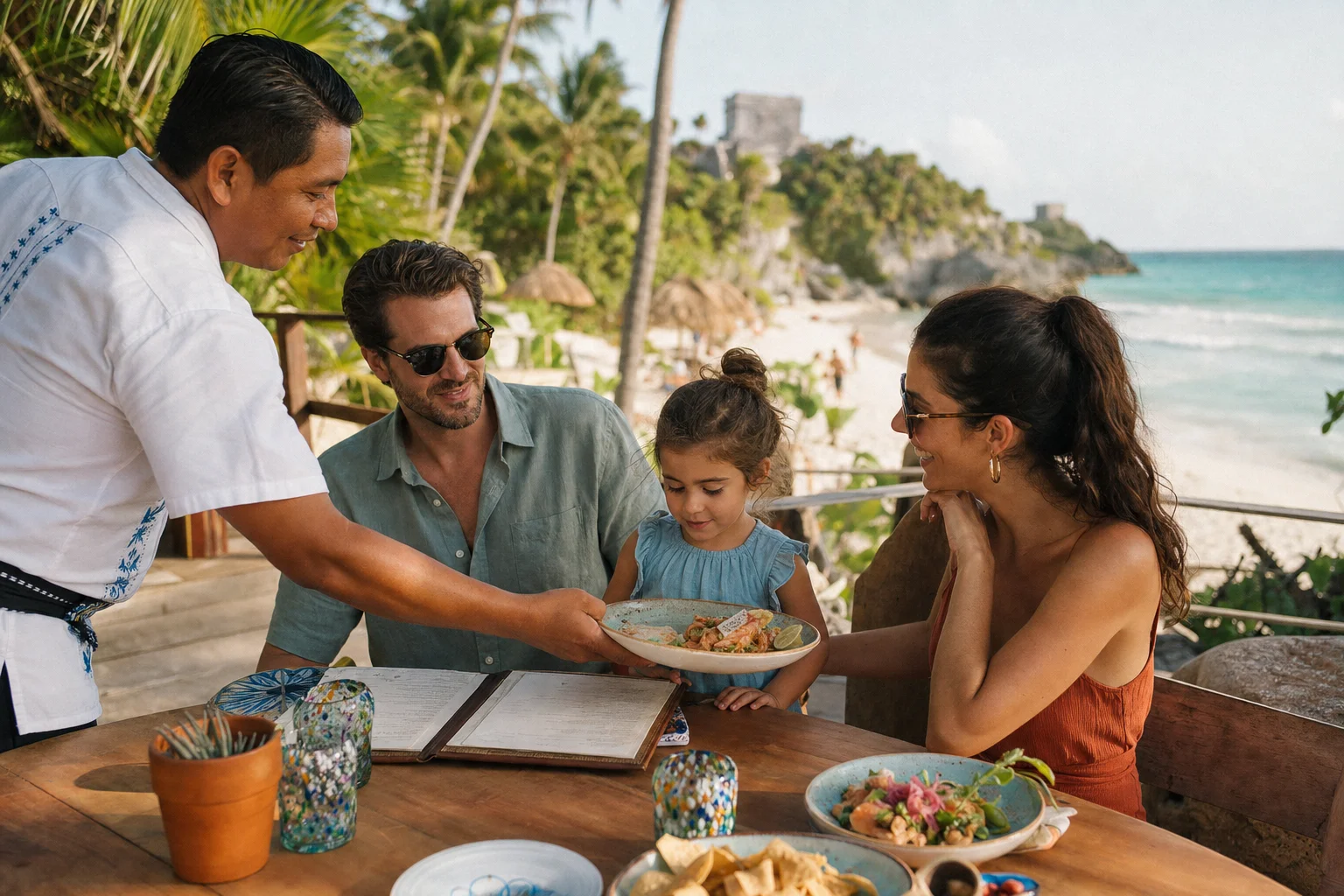
Every all-inclusive resort in the Riviera Maya will tell you it handles dietary restrictions. Most of them mean it sincerely. What they mean by it varies so much that the phrase has become nearly useless for deciding where to book - a resort with a dedicated gluten-free kitchen and a resort with a well-meaning server who’ll “ask the chef” both technically qualify.
The gap matters most if you have celiac disease or a severe nut allergy. At those severity levels, the difference between a separate kitchen with its own cookware and a verbal request passed along a buffet line is the difference between a vacation and a sick trip. This page gives you the real tier breakdown, which properties have the infrastructure to back up their marketing, and what Mexico’s own cuisine will throw at you that US resort travel never prepared you for.
What “we handle all dietary needs” actually means
The resort dining market in the Riviera Maya has three functional tiers, and the language used at each sounds identical from the outside.
Tier one - dedicated kitchen infrastructure
Grand Velas Riviera Maya maintains a dedicated gluten-free preparation area across all seven of its gourmet restaurants, with separate cookware and utensils rather than a designated section of shared equipment. Restrictions entered at check-in trigger automatic notification to all dining outlets before you sit down - the kitchen knows before you order. El Dorado Royale goes further: a physically separate kitchen used exclusively for gluten-free preparation, a stand-alone GF menu, and staff trained to treat every gluten-free order as a severe celiac reaction regardless of what the guest self-reports. Barcelo Maya Palace has a dedicated allergy-free kitchen for buffet preparation and gives you an allergy card at check-in that the host at every restaurant sees before you’re seated.
Tier two - formalized card programs with shared kitchens
Grand Palladium Riviera Maya uses a dietary card system - declare your restriction at check-in, receive a card specifying it, show it at each venue, and the maitre d’ or executive chef handles the rest. Cards exist for celiac, nut, dairy, egg, shellfish, and others. The buffet uses plexiglass drawers to reduce cross-contamination and chefs will walk you through what’s safe. UNICO 20°87° Hotel Riviera Maya creates bilingual allergy cards kept on file, separates buffet preparation for breakfast and lunch, and has produced custom allergen-free desserts on request - a nut-free almond-shaped candy made without nuts, by some accounts. These properties take it seriously. They don’t have the same hard separation as tier one.
Tier three - verbal acknowledgment
This is most of the market. Staff take the request, a server tells the kitchen, and the outcome depends on whether the person who cooked your dish that shift understood the question. Nickelodeon Hotels and Resorts Riviera Maya is an honest example of what this tier looks like at its best: staff check in about allergies at every restaurant seating, chefs adjust dishes to order, and the resort explicitly markets to families with children who have dietary restrictions. It’s genuinely well-intentioned. It’s also entirely verbal, and verbal systems have verbal failure rates.
The Hotel Riu Palace Riviera Maya markets gluten-free options but one documented 2025 review reports cross-contamination causing illness on the second night. Hilton Tulum Riviera Maya had items labeled “vegan” in 2025 that contained brioche buns and cheese - not a malicious failure, but a labeling and training breakdown that suggests the program isn’t centrally managed.
Where to eat safely by need
For celiac disease or severe gluten sensitivity
Grand Velas Riviera Maya is the strongest overall program among Riviera Maya all-inclusives, with documented separate prep area, menu icons on all restaurant menus (not a separate allergy menu - the regular menu, marked), system-wide check-in notification, and 24-hour gluten-free room service. Multiple long-stay reviews from celiac travelers report completing full weeks without incident.
El Dorado Royale has the most rigorous celiac protocol in the region - the dedicated separate kitchen, the stand-alone GF menu, and the policy of treating every order as severe regardless of self-report. The drawback is that El Dorado Royale is adults-only. It’s the right choice for a couple where one partner has celiac and the stakes of a cross-contamination incident are high.
Barcelo Maya Palace is the strongest family-friendly option with formal infrastructure. Multiple reviewers document seven-day stays without incident, including guests with severe celiac. The important caveat: Barcelo operates a complex of interconnected sub-resorts under the Maya brand. The detailed reviews apply to Palace specifically; the other sub-properties (Colonial, Tropical, Beach) have different kitchens and different F&B management.
At mid-tier properties, room service often outperforms restaurant dining for cross-contamination control - a quieter, smaller kitchen with more visibility on your specific order. This is the kind of tip that tends to come from travelers who’ve been glutened once at a buffet and adapted.

If you’re choosing between Grand Velas, El Dorado Royale, and Barcelo Maya Palace based on your specific celiac severity and travel party, Mira can walk through the documented protocol differences and check availability for your dates.
AI travel agent
For plant-based and vegan eating
Palmaia - The House of AiA is the only property in the region where plant-forward is the actual default and animal proteins are the item you request. Every other all-inclusive in the corridor has the ratio reversed. Six restaurants plus a vegan taco truck and a bakery/cafe, all with vegan defaults. A 2024 reviewer noted the kitchen noticed her dietary choices and started sending appropriate dishes without prompting on subsequent courses - the infrastructure is set up to observe and adapt rather than just respond to requests. Gluten-free is also handled proactively here. The pricing is at the premium end of the corridor.
JOIA Paraiso by Iberostar earned Vegan Hospitality Certification in January 2026 after a six-month collaboration that re-engineered more than eight menus, trained over 200 staff, and converted standard breakfast items like pancakes and waffles to fully vegan versions. The result is 30% plant-based across all dining venues, with three restaurants offering dedicated full vegan menus rather than labeled sections. This certification is externally audited, which distinguishes it from resorts that self-declare plant-based credentials. Adults-only property.
Hotel Xcaret Arte has Apapachoa, a standalone 100% plant-based rooftop restaurant open all day - not a section, a full restaurant. The property also features Encanta, led by Michelin-star Chef Paco Mendez, serving elevated Mexican cuisine. The adults-16-plus format and premium pricing make it a different trip profile than a standard all-inclusive, but for a couple where one partner eats plant-based and the other wants a serious Mexican tasting menu, this is the only property in the corridor where both are genuinely available.
For peanut and tree nut allergies
UNICO 20°87° is the property most specifically cited by allergy-travel reviewers for nut allergy management - bilingual cards on file, custom nut-free desserts confirmed in multiple reports, separated buffet prep. Spokin user reports single it out for peanut and nut allergies in particular.
Barcelo Maya Palace has multiple documented reports of chefs coming out of the kitchen after seeing a nut allergy card at seating, which is the behavior you want. The honest context from the same reviewers: peanut butter cups are at the breakfast buffet, nuts appear in the lobby bar. This is the resort treating the allergy seriously on your plate. The lobby bar and the breakfast buffet still have nuts in them.
For kosher dining
The landscape changed in 2025. Grand Hyatt Playa del Carmen dropped its kosher options in summer of that year. Grand Velas Riviera Maya added kosher and kosher-lite dining options as of 2025. Rosewood Mayakoba has a formal kosher dining booklet and works with The Ember, described as the most established kosher supplier in the region. Banyan Tree Mayakoba also works with The Ember with advance notice. If kosher is a hard requirement for your trip, contact the resort’s food and beverage department before booking to confirm current program status - this is an area where offerings have been actively changing.
Mexico’s hidden kitchen risks
This is the section that doesn’t appear in resort marketing because it applies to the cuisine itself - risks that exist at properties that are genuinely trying.
Mole is the first trap. Traditional mole negro, rojo, and coloradito use breadcrumbs as a thickener - in addition to or instead of wheat flour. Staff who understand “no wheat flour” may still be unaware that the bread thickener is the issue. The right question at any resort restaurant is whether a dish contains “pan” - any bread, breadcrumbs, or toast. Verbal requests that use the word “wheat” often get an honest “no” answer that is also technically inaccurate.
Marinades are the second. Carne asada, cochinita pibil, and many grilled meat preparations at resort restaurants use Salsa Inglesa (Worcestershire sauce) or Maggi sauce as a base marinade. Both frequently contain wheat. Ordering “plain grilled meat” does not guarantee a wheat-free version unless the resort has a documented celiac protocol - the marinade is applied before the kitchen receives your allergy request.
Shared fryers are the third. Corn tortilla chips and flour tortilla chips share fryers at most buffet stations. Tortillas themselves are sometimes stored on the same surface or made with shared equipment. At properties without dedicated prep infrastructure, asking about cross-contamination at the fryer is a separate question from asking about the dish itself.
These risks exist at properties that are genuinely trying to handle dietary restrictions well. They’re not failures of intent - they’re gaps in the specific knowledge that US-trained kitchen staff would have absorbed from ADA-era food handling training, knowledge that doesn’t exist in the same form in Mexican culinary culture. The tier-one properties have closed the gaps through documented training programs. The verbal-request tier has not.
What to do before you arrive
Email the F&B department before arrival
Multiple allergy travelers have documented the same pattern: dietary notes added to an OTA booking confirmation never reached the kitchen, while an email directly to the food and beverage department - addressed to a named contact - resulted in the kitchen being ready when they checked in. This is a separate step from your booking - it supplements it, and does not replace it. It’s especially important at resorts with formalized allergy card programs, which work best when triggered by pre-arrival communication rather than discovered at check-in.
Bring Spanish allergy cards
Equal Eats (equaleats.com) produces plastic allergen cards in Latin American Spanish with precise phrasing - a gluten card that specifies not just wheat but also bread, barley, rye, and breadcrumbs as hidden sources; a nut card that lists pistachios and cashews explicitly. Multiple reviewers of Barcelo Maya Palace specifically note that showing one of these cards caused the chef to come out of the kitchen - the card communicates specificity that verbal requests in English cannot. Selectwisely.com is another commonly cited source for the same category of card.
Use room service as backup at mid-tier resorts
If you arrive and the restaurant experience is making you nervous, room service from the same resort’s kitchen often offers better cross-contamination control because the order is smaller, more visible, and handled by fewer people. Pack some backup supplies for long stays regardless - a small bag of safe snacks for travel days covers the moments between checking in and confirming the kitchen understands your situation.
Tell Mira your specific dietary restriction and she can check which properties in your dates have the documented kitchen infrastructure to handle it, and flag the pre-arrival contact process for each one.
AI travel agent
The buffet problem
Buffet labels at Riviera Maya resorts drift during service. A dish labeled gluten-free at 7am may be replaced mid-service with a non-GF version without the label being updated. This is documented at multiple properties including Vidanta Riviera Maya. At any resort with an allergy card program, the better approach is to ask the buffet manager for a tour of safe items rather than relying on labels alone - a chef walking you through is standard practice at Grand Palladium and significantly more reliable than label-reading.
Peanuts exist everywhere even at allergy-aware properties. Peanut butter cups appear at breakfast buffets, nuts show up in lobby bar snacks, and the mini-fridge stocked in your room at arrival may contain tree nuts. Resorts with good allergy programs prevent peanuts from reaching your plate; they do not run peanut-free environments. Families managing anaphylaxis-level reactions should plan for ambient peanut exposure on the property and carry their medication accordingly.
One last property-specific warning: Grand Palladium operates four sub-resorts within its Riviera Maya complex - Colonial, White Sand, TRS Yucatan, and Kantenah. Traveler reports document strong celiac protocols at some sub-properties and a cross-contamination incident causing significant illness at another, with the difference attributed to different F&B management. The same brand name does not mean the same kitchen. If you’re considering the Grand Palladium complex, identify the specific sub-property in your booking and research that one.
Frequently Asked Questions
Can I eat safely at an all-inclusive in Riviera Maya if I have celiac disease?
Is mole sauce gluten-free at resort restaurants?
Which Riviera Maya resort is best for vegans?
Do I need to notify the resort about a food allergy before I arrive?
Are peanuts present at allergy-aware Riviera Maya resorts?
Are there kosher options at Riviera Maya resorts?
More articles about Riviera Maya
Destination Guide
-

Riviera Maya Family Vacation Guide (2026)
Most families pick the resort and learn the base town matters more - and they pick a beach week without checking which months the beach actually exists.
-

Riviera Maya for First-Time Visitors
Nearly 100 miles of coast - the base you pick changes everything about what your trip becomes.
Who's Traveling
-

Riviera Maya for Large Families: Rooms That Actually Connect
The difference between a connecting room guarantee and a connecting room request - and which resorts have actually built the first one.
-

Multi-Generational Riviera Maya: What Actually Works
The all-inclusive format removes the per-meal friction - but the wrong resort turns a reunion into a scheduling problem before day two.
-

Riviera Maya with Grandparents: Resorts That Work
The all-inclusive format removes the logistics burden - but the wrong resort turns into an endurance test before lunch.
-

Riviera Maya with a Baby
The trip works when you book one of the five resorts that actually built for it.
-

Riviera Maya with School-Age Kids (Ages 6-12)
The cenotes, ruins, and eco-parks were all built for exactly this age window.
-

Riviera Maya with Teens
The resort question that matters most, the excursion layer that makes the trip, and the things nobody tells you until it's too late.
-

Riviera Maya with a Toddler
The resort you pick determines whether you get a trip or a survival exercise.
Sensory & Accessibility
-

Sensory-Friendly Riviera Maya: What's Actually There
Two certified resorts, one visitor guide worth downloading, and the pre-arrival steps that determine whether any of it actually works.
-

Low-Stimulation Riviera Maya: Quiet Zones and Calm Days
The destination defaults to DJ pools and nightly fire shows. The quiet version is real - you just have to know which section to book.
-

Quiet Stays in Riviera Maya: What Actually Works
Most resorts say serene. A few actually are. Here's how to tell the difference before you book.
-

Sensory-Friendly Riviera Maya: What's Actually There
Three resorts have certification programs. The properties that actually work for low-stimulation families have no label at all.
-

Wheelchair-Accessible Riviera Maya: What to Book
The terrain works in your favor. The booking language does not.
Food


Room Setup
-

Riviera Maya Connecting Rooms: Who Guarantees the Door
The difference between a resort that notes your request and one that actually holds the room.
-

Family Suites in Riviera Maya
The connecting-room guarantee is the thing to verify - everything else follows from there.
-

Riviera Maya Hotels with Kitchenettes for Families
The label "kitchenette" covers everything from a stocked fridge with free juice to a four-burner gourmet setup with a dishwasher. Ask first.
On-Site Activities
-

Riviera Maya Kids Clubs
The phrase "kids club included" covers everything from mangrove boat rides to a TV in a locked room. Here's how to tell the difference before you book.
-

Riviera Maya Resorts With a Lazy River
Not every "lazy river" in the brochure moves on its own - the gap between marketing and a real float is wider here than anywhere else in Mexico.
-

Riviera Maya with a Water Park
Some families want the water park at the hotel. Others want a day excursion to Xel-Ha. Confusing the two is how trips go sideways.
Powered by Mira
Tell Mira about your family
Two minutes of conversation. A shortlist of hotels that actually fit — connecting rooms, accessible layouts, calm floors, whatever your family needs.
AI travel agent · free to try
Talk to Mira Let Mira find the right hotels for your family. Find hotels with Mira
AI travel agent · free to try