
Mexico Caribbean
Low-Stimulation Riviera Maya
The destination defaults to DJ pools and nightly fire shows. The quiet version is real - you just have to know which section to book.
AI travel agent · free to try
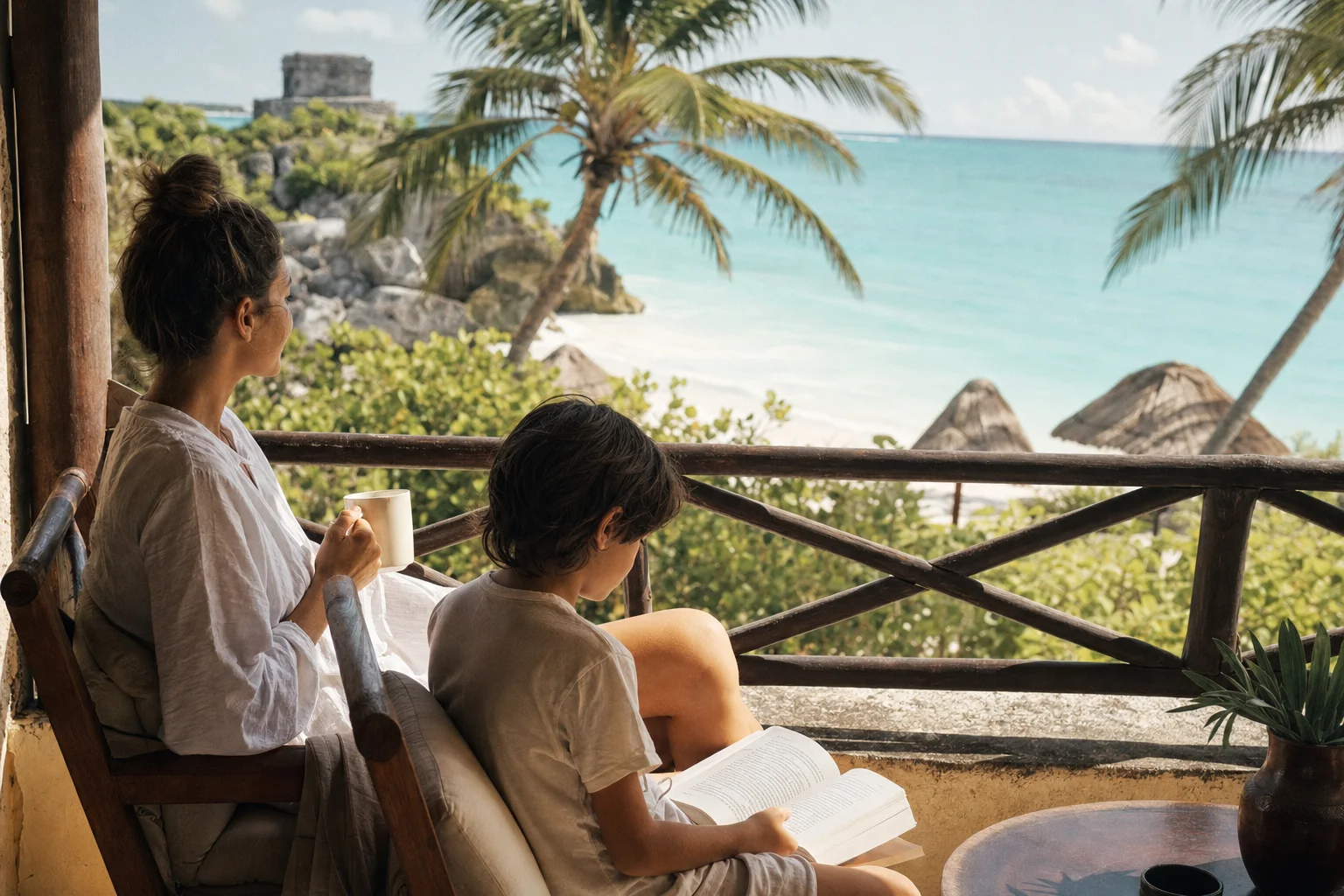
Most Riviera Maya all-inclusives are deliberately engineered to keep you stimulated. Pool games start at noon, amplified music runs until the swim-up bar closes, and the nightly entertainment schedule - fire shows, live bands, DJ sets - fills every quiet gap before 10pm. For most guests, that’s exactly what they came for. For families who need a different environment, it just means you have to be more specific about what you book.
The quiet version of this destination exists and is genuinely good. The problem is that nothing in the resort marketing tells you where it is.
Why resort design determines your noise floor
The distinction that matters at Riviera Maya all-inclusives isn’t “family-friendly” versus “adults-only” - it’s whether the property has multiple pool areas with meaningfully different activity levels. At most mega-resorts, there’s one main pool running DJ sets and foam parties from the early afternoon, and one secondary pool that operates at a lower volume. The gap between them can be dramatic. A reviewer at Hard Rock Riviera Maya described the Hacienda Rojo section’s daily foam party and amplified games, and the Hacienda Azul pool as “quieter, more relaxed, beautifully landscaped” - same resort, two entirely different sensory environments.
The challenge is that “quieter secondary pool” is not a guaranteed feature. At Grand Bahia Principe Coba, construction removed the quiet pool in 2024. At some resorts the secondary pool is adults-only. Before booking any large all-inclusive based on reviews mentioning a calm pool, call the resort and ask directly: is there a family-accessible pool away from amplified music and pool games, and is it open now?
The properties that deliver reliably on quiet do so through physical design rather than intention. Private plunge pools, villa formats, jungle or lagoon settings that insulate from crowd energy, and resort sections with their own distinct pool and common areas are the structural markers. These tend to correlate with premium pricing, which is the honest tradeoff: the affordable all-inclusive tier in Riviera Maya is built almost universally around high-energy entertainment.
Hotels worth booking for actual calm
Rosewood Mayakoba
Rosewood Mayakoba is the most reliably low-stimulation full-service family resort in the region, and the physical design explains why. Every villa has a private plunge pool, so water access never requires navigating shared resort spaces when the kids aren’t in the mood for people. Getting to your villa from the lobby involves boarding a covered wooden Duffy boat on the resort’s lagoon network - no shuttle queue, no crowded walkways, a two-minute transit through a 600-acre forest and lagoon complex where the ambient noise runs to birds. The resort has two pools with a clear activity split: the Casa del Lago pool inland is consistently described as “much quieter and calmer” with a welcoming rather than stiff atmosphere; the Punta Bonita beach pool is the active family hub. One parent reviewer put it simply: “You will finally get to read that book. You will finish an entire cup of coffee while it’s hot.”
A 30-minute guided lagoon boat tour with a naturalist is included for guests - turtles, nesting birds, and small crocodiles at close range, with a small group and no performance element. Safety gates around all villa water features are installed automatically. Rose Buds Kids’ Club runs optional activities (ceramic painting, eco-tours, cooking classes) with no mandatory participation.
The price is a real number and is in the premium tier. For families where private water access and low-density surroundings genuinely change the quality of the trip, the math usually works.
Grand Velas Riviera Maya - Zen section
The Zen section at Grand Velas is the strongest quiet-zone option inside a large all-inclusive. It’s set inland from the beach in a jungle corridor, accessed via palapa-covered walkways, and the ambient noise is birdsong. The Zen pool is consistently described as the quietest on the property. The section has its own Kids’ Club for ages 5-12 with its own schedule, separate from the Ambassador section’s activity program. Rooms open directly onto jungle greenery.
The trade-off is real: the Zen section has no direct beach access. The beach is in the Ambassador section, accessed by a shuttle that guests describe as a 3-minute wait. For families who want a genuinely calm room environment and quiet daytime pool but are happy to take the shuttle for beach afternoons, the arrangement works well. Families who need beach access integrated into daily management - for energy-regulation reasons, mobility reasons, or just the logistics of young children - should factor in the dependency. Also: the jungle setting produces insects. Bring repellent.
Hard Rock Riviera Maya - Hacienda Azul
Hard Rock runs three distinct zones at different noise floors: Hacienda Rojo (daily foam parties, live entertainment, the loud end), Hacienda Azul (quieter, more relaxed, “beautifully landscaped”), and Heaven (adults-only). Azul is the middle option for families who want all-inclusive convenience with lower daytime pool energy. Guests in Azul still have access to all resort facilities, so you’re not walled off from the entertainment if your kids want it in the evening. Request Hacienda Azul at booking explicitly - the resort doesn’t route families there by default.

The split between Rosewood’s private-pool design and Grand Velas’ quiet-zone-within-a-resort model comes down to what your family actually needs on a hard day. Tell Mira your specific situation and she’ll help you figure out which property format matches it.
AI travel agent
Puerto Morelos and Akumal: the quiet base towns
The Riviera Maya corridor runs from Cancun in the north to Tulum in the south, with Playa del Carmen roughly in the middle. Puerto Morelos sits about 30 minutes from both Cancun airport and Playa del Carmen, and it has developed into neither. Restaurants and bars close by 11pm. There’s no nightclub infrastructure, no party energy, no timeshare corridor. The central beach is shallow, calm, appropriate for young children, and has a town square playground two minutes’ walk from the water.
Puerto Morelos also has a practical advantage for families tracking sargassum: the town funds its own seaweed mitigation barriers, and the central beach stayed clearer than surrounding areas through the 2025 spring season. That’s not a guarantee, but it’s an active management effort that most Playa del Carmen and Cancun properties don’t have.
Smaller boutique options here include Areia Boutique Hotel (rooftop pool, ocean views) and Ojo de Agua (private beach club, low-rise). If your budget allows it and you’re willing to stay outside a mega-resort, base-camping in Puerto Morelos and doing activities gives you a fundamentally different experience than an all-inclusive in the hotel zone.
Akumal is 45 minutes south and closes even earlier - town shuts down by 10pm. The protected bay creates flat, calm water and is known for sea-turtle sightings from the main beach. The public beach area gets midday tour-group crowding, which you avoid by arriving before 9am. Everywhere else in town, consistently described as entirely peaceful.
The low-stimulation activity circuit
The quietest water experience in Riviera Maya isn’t a resort pool - it’s an underground cenote. Still freshwater at a steady 77 degrees year-round, cool air, small visitor groups, no amplified sound, and the enclosed rock naturally muffling anything from outside. Every element of a beach day that creates sensory load (wave risk, crowd density, sun intensity, ambient noise, and sargassum smell) is absent. Two options worth knowing:
Yal-Ku Lagoon
Yal-Ku Lagoon in Akumal is a protected freshwater-saltwater inlet with no wave action, dense marine life, easy shore entry, and small-scale facilities. It doesn’t appear on most mainstream tour itineraries, which keeps the visitor count low. Reviewers who arrived at 11am described the place as “practically to ourselves - spotless, great facilities, lovely outdoor restaurant.” Arrive before noon. Best for school-age children and adults; young children can wade in the shallow entry area.
Cenote Yax-Kin
Cenote Yax-Kin is an open-air cenote with minimal tour-group presence - mostly locals and expats - and a shallow splash zone that works for babies and toddlers. Described as “excellent for adults, kids, toddlers and babies.” Not heavily marketed, which is the reason it stays calm.
For a park day, Xel-Ha is the correct choice from the Xcaret group. Self-directed natural lagoon, no performance schedule, lazy river through mangroves, half-day format available. Arrive at 8am (opening) to have the lagoon nearly to yourself. The Xcaret Park alternative - specifically the Pueblo section - is consistently described as overwhelming even by reviewers without sensory-sensitive children. You can structure a Xcaret day around the turtle sanctuary, aviary, and underground river while staying out of the Pueblo section, but that requires real advance planning and is easier to get wrong.
If you’re building a day-by-day activity plan around which cenotes, towns, and parks stay low-volume and when, tell Mira your dates and she’ll sequence it so the busy options land on the right days.
AI travel agent
What families get wrong
The most common mistake is booking a “family-friendly” resort based on kids’ club size and water park coverage, then being surprised by the pool energy. In Riviera Maya marketing, “family-friendly” describes the entertainment programming - it says nothing about ambient noise level. A resort can run foam parties and DJ sets six days a week and still be accurately described as family-friendly.
The Cancun airport arrival is worth planning separately. It processes roughly 30 million passengers a year, and at peak times the immigration queues are long, crowded, and loud. Off-peak arrivals - early morning, midweek - reduce the exposure. A pre-booked private transfer over a shared shuttle matters here: no waiting for other passengers, no additional stops, faster transit to your hotel.
Sargassum is an underreported sensory issue. It gets covered as a beach-quality concern for swimmers but almost never discussed in the context of smell - seaweed decomposition produces a strong sulfur smell that can override everything else about a beach day. April through July is peak season. Puerto Morelos central beach has active mitigation. Cenotes are entirely unaffected. Check howisthesargassum.com or sargassummonitoring.com within 30 days of travel.
One property specifically to watch: The Fives Oceanfront in Puerto Morelos has reviews ranging from “super relaxed” to “extremely loud” from the same period. The inconsistency tracks to event bookings - weddings and groups create noise spikes that don’t appear in a resort’s standard description. If you’re booking The Fives, confirm your dates against their event calendar before finalizing.
Frequently Asked Questions
Which Riviera Maya resorts have a quiet pool separate from pool music and games?
What's the quietest town to stay in along the Riviera Maya?
Are cenotes good for kids who get overwhelmed at crowded beaches?
Will sargassum be a problem at the beach?
Is Xcaret too overwhelming for families? Is there a calmer park alternative?
More articles about Riviera Maya
Destination Guide
-
Riviera Maya Family Vacation Guide (2026)
Most families pick the resort and learn the base town matters more - and they pick a beach week without checking which months the beach actually exists.
-

Riviera Maya for First-Time Visitors
Nearly 100 miles of coast - the base you pick changes everything about what your trip becomes.
Who's Traveling
-

Riviera Maya for Large Families: Rooms That Actually Connect
The difference between a connecting room guarantee and a connecting room request - and which resorts have actually built the first one.
-

Multi-Generational Riviera Maya: What Actually Works
The all-inclusive format removes the per-meal friction - but the wrong resort turns a reunion into a scheduling problem before day two.
-

Riviera Maya with Grandparents: Resorts That Work
The all-inclusive format removes the logistics burden - but the wrong resort turns into an endurance test before lunch.
-
Riviera Maya with a Baby
The trip works when you book one of the five resorts that actually built for it.
-

Riviera Maya with School-Age Kids (Ages 6-12)
The cenotes, ruins, and eco-parks were all built for exactly this age window.
-
Riviera Maya with Teens
The resort question that matters most, the excursion layer that makes the trip, and the things nobody tells you until it's too late.
-

Riviera Maya with a Toddler
The resort you pick determines whether you get a trip or a survival exercise.
Sensory & Accessibility
-

Sensory-Friendly Riviera Maya: What's Actually There
Two certified resorts, one visitor guide worth downloading, and the pre-arrival steps that determine whether any of it actually works.
-
Quiet Stays in Riviera Maya: What Actually Works
Most resorts say serene. A few actually are. Here's how to tell the difference before you book.
-

Sensory-Friendly Riviera Maya: What's Actually There
Three resorts have certification programs. The properties that actually work for low-stimulation families have no label at all.
-

Wheelchair-Accessible Riviera Maya: What to Book
The terrain works in your favor. The booking language does not.
Food
-

Dietary Accommodations at Riviera Maya Resorts
"We accommodate all dietary needs" means something very different depending on which resort said it.
-

Food Allergy Travel in Riviera Maya: What Works
Several resorts have documented allergy programs. The ones that hold at the plate are a shorter list.
-

Riviera Maya for Picky Eaters
The all-inclusive model lets your kid order, reject, and reorder without you doing math at the table.
Room Setup
-

Riviera Maya Connecting Rooms: Who Guarantees the Door
The difference between a resort that notes your request and one that actually holds the room.
-
Family Suites in Riviera Maya
The connecting-room guarantee is the thing to verify - everything else follows from there.
-
Riviera Maya Hotels with Kitchenettes for Families
The label "kitchenette" covers everything from a stocked fridge with free juice to a four-burner gourmet setup with a dishwasher. Ask first.
On-Site Activities
-

Riviera Maya Kids Clubs
The phrase "kids club included" covers everything from mangrove boat rides to a TV in a locked room. Here's how to tell the difference before you book.
-

Riviera Maya Resorts With a Lazy River
Not every "lazy river" in the brochure moves on its own - the gap between marketing and a real float is wider here than anywhere else in Mexico.
-

Riviera Maya with a Water Park
Some families want the water park at the hotel. Others want a day excursion to Xel-Ha. Confusing the two is how trips go sideways.
Powered by Mira
Tell Mira about your family
Two minutes of conversation. A shortlist of hotels that actually fit — connecting rooms, accessible layouts, calm floors, whatever your family needs.
AI travel agent · free to try
Talk to Mira Let Mira find the right hotels for your family. Find hotels with Mira
AI travel agent · free to try