
Florida
Sensory-Friendly Miami
Florida's most structured city for low-stimulation travel - if you know which 4 miles of beach to avoid.
AI travel agent · free to try
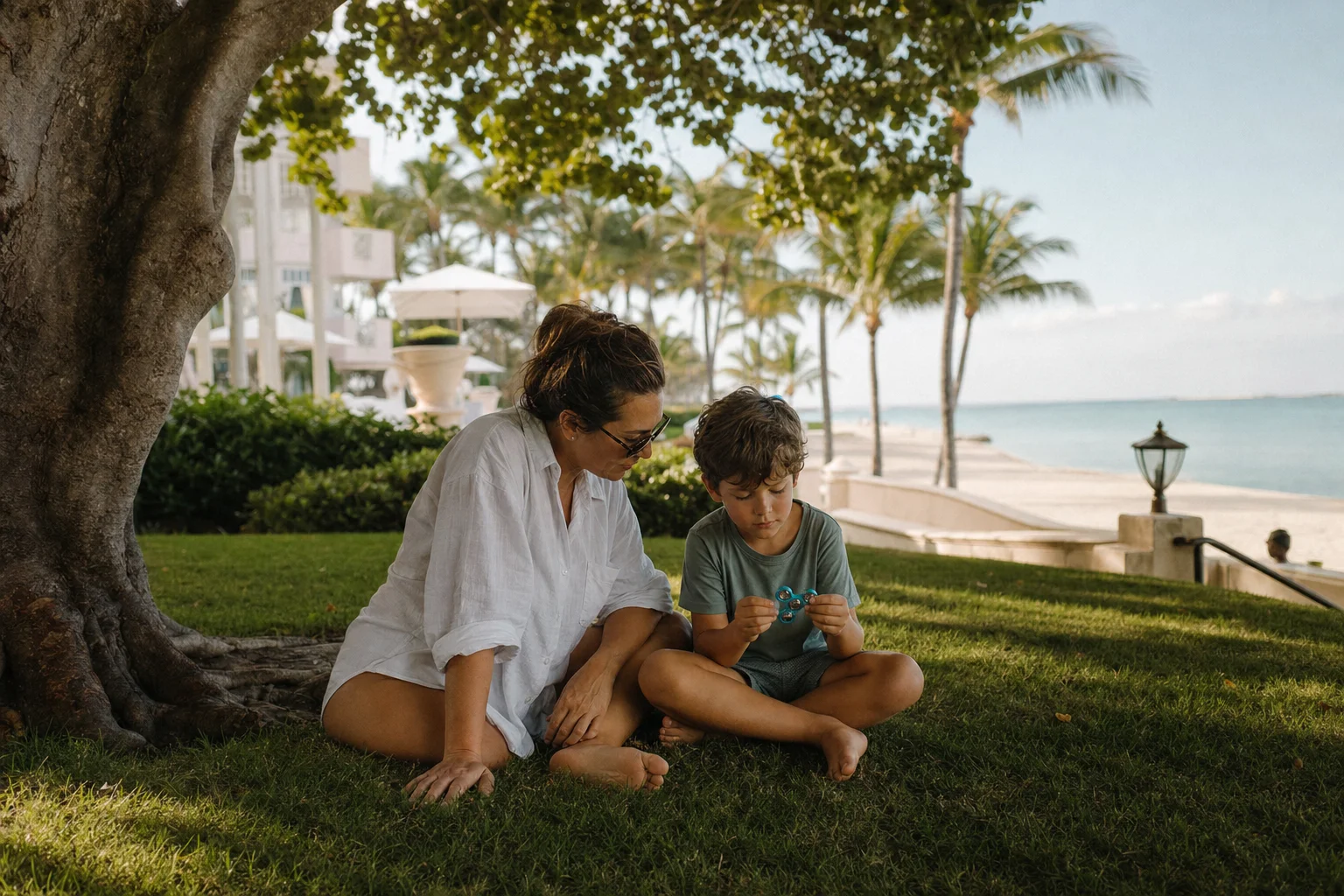
The city’s reputation is well-earned. Ocean Drive on a Friday night, Wynwood on a Saturday, the pools at any large South Beach resort - Miami runs loud and stimulation-dense in the places that show up on travel magazines. What those same guides skip: Miami has more formal, recurring, low-stimulation programs than almost any other major US city. The network is scheduled and verifiable, not ad hoc. The work is knowing where to find it - and which 4 miles of beach to route around.
What’s actually been built here
The foundation is a local partnership between CARD at UM-NSU - the Center for Autism and Related Disabilities at the University of Miami - and a set of Miami cultural institutions that have agreed to structured sensory-modification protocols. This isn’t a PR campaign. Frost Science Museum, Superblue Miami, New World Symphony, and Miami Children’s Museum are all CARD-affiliated venues with ongoing certification. Zoo Miami holds IBCCES Certified Autism Center (CAC) status - Florida’s first - which requires a staff training audit, an environmental review, and ongoing renewal.
What that means practically: when Frost Science says it runs “Just for Me” sessions the third Wednesday and third Saturday every month, the modification is exhibit-level specific - dinosaur sounds off in Ultimate Dinosaurs, game sounds muted in Power of Science, brighter lights and lower volume in The Deep aquarium. Noise-reducing backpacks (earmuffs plus sensory toys, adult and child sizes) are available at the front kiosk on first-come lending. A printable museum guide maps every room’s modifications so you can preview each space before you arrive. This is not a vague “quieter environment” promise.
Miami Children’s Museum Sensory Friendly Saturdays are free and run the second Saturday monthly, 9–11 AM, with limited admission. The museum opens early with lowered sound and lighting throughout. The permanent Snoezelen Room - a multi-sensory calm space designed in partnership with Beit Issie Shapiro - is built into the museum itself, not limited to event hours. RSVP closes the Friday before; the organizers explicitly ask for cancellations so waitlisted families can register. Email sensorysaturday@miamichildrensmuseum.org.
Superblue Miami’s immersive art installations - large open rooms, touch-friendly surfaces, no loud narration - are already lower-stimulation than most entertainment venues at baseline. The dedicated monthly sensory session (third Thursday) takes it further: reduced sound and lighting, limited admission, quiet rooms, sensory kits. Cristina Castañeda’s son Lucas responded to a regular visit - “He could touch the walls, see things bloom - it was calm.” The sensory session is a lower floor than that baseline.

The monthly program calendar is the most load-bearing part of planning a Miami trip for families who need predictability. Mira can map these dates against your travel window and show you which ones stack into a full day.
AI travel agent
The beach decision
South Beach is the wrong starting point for families with low-stimulation needs. Ocean Drive and Lummus Park function more like an amusement park than a beach - vendors, club music, parasailing takeoffs, beach chair rows, and a crowd that builds through the day. The answer isn’t to skip Miami beaches. The answer is to drive 20 minutes south.
Crandon Park Beach on Key Biscayne
Crandon Park Beach on Key Biscayne is the single strongest beach recommendation that comes out of this research. A natural offshore sandbar produces calm, shallow water across a wide stretch of beach. On weekday mornings, reviewers document walking several minutes before passing another person - “you actually can rest here,” one Tripadvisor writer noted; “I sat, ate, and fell asleep under the palm trees.” The North Beach section within Crandon is calmer still. The whole island has no nightclub strip; Key Biscayne nights are residential and quiet. Lifeguards on duty. Free parking with entry fee to the park.
The caveat to state plainly: sargassum seaweed is a real seasonal variable. A July 2025 Tripadvisor review documented overpowering odor making the ocean unusable that visit. Summer months - roughly June through August - carry higher sargassum risk. Check Biscayne Bay water quality before you go.
Matheson Hammock Park
Matheson Hammock Park (Coral Gables, about 15 minutes from downtown) solves a different problem. The man-made atoll pool - a tidal lagoon enclosed by a limestone ring - produces completely flat water with no wave variation. For children frightened by surf, disoriented by open-water depth changes, or dysregulated by unpredictable ocean movement, this is the structural fix. Three lifeguard towers on weekends plus a patrol lifeguard. The park is 630 acres with picnic areas, mangrove trails, and kayak and paddleboard rentals - more enclosed than Crandon, which some children find easier than open-horizon ocean views.
“If you want a sheltered swimming cove that is uncrowded, peaceful with just a few other families around, this is your spot,” one reviewer wrote. It doesn’t produce the wide-beach solitude of Crandon, but it removes the variables that make ocean swimming hard.
Before you land and after you clear security
Miami International Airport has a multi-sensory room in Concourse D, post-security, adjacent to TSA Checkpoint 4. Open 6 AM–10 PM daily. The room has an aquatic bubble tube, a light projector, wall puzzles, cushioned seating, and dim lighting. Free, no reservation required. MIA also runs MIAair, a pre-visit program that lets families tour the airport before their travel day.
This room appears in exactly one sensory travel roundup - it’s almost never mentioned in family travel content. A family landing after a disrupted flight has a free purpose-built decompression room available within 30 minutes of touching down. Useful to know before the trip, not after.
Where to stay, geographically first
The simplest hotel strategy for low-stimulation stays: get off Miami Beach. Not because Miami Beach is bad - but because quiet evenings on the island depend entirely on which street you’re on.
South Beach from 5th to 23rd Street is the nightclub corridor. Hotels there are structurally embedded in late-night street noise regardless of their own soundproofing. Mid-Beach (24th–63rd) and North Beach (63rd–87th) are residential, with quieter beaches and more space. Surfside and Sunny Isles Beach, further north, are effectively different towns - calm, no nightlife scene.
The quietest base - Four Seasons Surf Club, Surfside
Four Seasons at the Surf Club in Surfside sits 5 miles north of South Beach - seventy rooms on 900 feet of beach. Boutique scale that keeps pool density low even when full, two pools (family and adults-only), and a neighborhood where reviews describe the beach as “pretty much yours.” The higher-budget option; worth it if a calm base is the priority.
Structured kids programming included - Acqualina, Sunny Isles Beach
Acqualina in Sunny Isles Beach sits eleven miles north of South Beach. A complimentary marine biology kids program (ages 4–12) and a stretch of Collins Avenue reviewers consistently describe as calm and residential at night. Verify current program details and check for active construction before booking.
Best structured option if you need South Beach - Loews Miami Beach
Loews Miami Beach at 16th Street is the most family-structured option for families who need to be on the strip. Kids club for ages 4–12, sloped-entry pool, direct beach access - positioned north of the main nightclub concentration. Loews was mid-renovation through November 2025; verify guest room status before booking.
The tradeoffs here are real - Surfside is genuinely quieter but means commuting if your family wants to see South Beach. Tell Mira your non-negotiables and she can show you which hotel geography actually fits.
AI travel agent
Timing fixes for three common missteps
Wynwood works before 11 AM on a weekday - roads less crowded, vendors not yet set up, the murals worth seeing on their own terms. On a Saturday evening it’s bar traffic and street music. The visit works; the scheduling matters.
South Beach mornings are a viable strategy. Arrive at 8 AM when the beach is coolest and emptiest, leave before noon when music and density build. The failure mode is booking a hotel in the 5th–23rd Street corridor and trying to get an early night.
Hotel pools are not interchangeable. Miami Beach hotel pools with DJ sets and social crowds are common - Fontainebleau’s main pools are the obvious example. A dedicated family pool (Loews’s sloped-entry pool, Four Seasons Surf Club’s family pool, Acqualina’s family beach area) is a different experience than the word “pool” in an amenity list.
Pre-registration is the variable most families miss. Miami Children’s Museum Sensory Saturdays close registration the Friday before at 5 PM. Frost Science “Just for Me” sessions fill. Superblue sensory sessions require advance tickets. Miami’s program ecosystem is real - and it rewards planning.
Frequently Asked Questions
What's the calmest beach near Miami for kids who are overwhelmed by waves or crowds?
Are there sensory-friendly programs in Miami with fixed monthly schedules?
Does Miami's airport have anything for kids who get overwhelmed before flights?
What Miami hotel works best for a family that needs a calm environment?
Is South Beach actually bad for families with sensory-sensitive kids?
What are the quietest outdoor options in Miami besides the beach?
More articles about Miami
Destination Guide
-

Miami Family Vacation (2026): What Actually Works
Most families book the wrong neighborhood, skip the Everglades, and don't find out what Miami actually costs until they check out.
-

First-Timer's Guide to Miami with Kids
The neighborhood you choose will determine almost everything else about your trip.
Who's Traveling
-

Miami with Large Families: Suites, Rentals, and Real Costs
The suite-vs-rental math, the resort fee reality, and the neighborhoods South Beach loyalists don't mention.
-

Multi-Generational Miami: What Actually Works
Three generations, two pool areas, one trip where nobody has to apologize for needing a rest.
-

Miami with a Baby: Where You Stay Is the Whole Trip
The neighborhood you book determines more than the hotel you book - here's how to read the map.
-

Miami with Grandparents
The city has real infrastructure for slow travel - free beach wheelchairs, step-free trolleys, a 7-mile coastal path - but it only pays off if you choose the right half of it.
-

Miami with School-Age Kids: What Actually Works
The city has no single family zone. Where you base yourself determines whether this trip works.
-
Miami with Teens
The city that works better than a theme park - if you stop trying to run it like one.
-

Miami with a Toddler: What Actually Works
The party-beach reputation misleads a lot of parents. The city is more workable than that - if you pick the right pocket of it.
Sensory & Accessibility
-
Miami for Families Who Need a Quiet Base
The certified infrastructure here is real, and more extensive than most families realize - but it only works if you start with the right neighborhood.
-
Low-Stimulation Miami: Where the City Actually Gets Quiet
The certification is about staff training. The geography is what actually controls the noise.
-
Quiet Hotels in Miami: Where to Actually Sleep
The noise in Miami is a geography problem. Pick the right neighborhood and the hotel choices follow.
-

Wheelchair-Accessible Miami: Beach Access & What to Verify
The beach access infrastructure is genuinely impressive. The sidewalks and the Metromover are not.
Food
-

Miami for Families with Dietary Restrictions
The culinary diversity here is structural, not cosmetic - it changes the math on where your family can actually eat.
-

Miami with Food Allergies
The city's cuisine identity - stone crab, ceviche, shared fryers - makes preparation non-optional.
-

Miami with a Picky Eater
The real challenge isn't finding plain food - it's knowing where not to eat.
Room Setup
-

Miami Connecting Rooms: Who Actually Guarantees It
The difference between a request and a guarantee - and the handful of Miami hotels that have actually solved it.
-
Miami Family Suites With Real Separation (and Real Kitchens)
"Suite" is one of the most abused words in Miami hotel marketing. Here's what to ask for - and where to find it.
-
Miami Hotels with Kitchenettes & Full Kitchens
Miami's dining costs make the kitchenette decision more consequential than almost anywhere else in the country - but "kitchenette" on Miami listings often means a mini-fridge and a microwave.
On-Site Activities
-

Miami Hotels with Kids Clubs: Who Actually Has One
Six hotels in Miami run genuine supervised drop-off programs. Several famous names no longer make the cut.
-

Miami Hotel with Lazy River: The Honest Answer
The aggregator lists are wrong. Here's what the Miami area actually has - and the one property worth booking.
-

Miami Water Parks
The honest answer is different from the one most travel sites give you - and knowing it saves a disappointing afternoon.
Powered by Mira
Tell Mira about your family
Two minutes of conversation. A shortlist of hotels that actually fit — connecting rooms, accessible layouts, calm floors, whatever your family needs.
AI travel agent · free to try
Talk to Mira Let Mira find the right hotels for your family. Find hotels with Mira
AI travel agent · free to try