
Florida
Low-Stimulation Miami
The certification is about staff training. The geography is what actually controls the noise.
AI travel agent · free to try
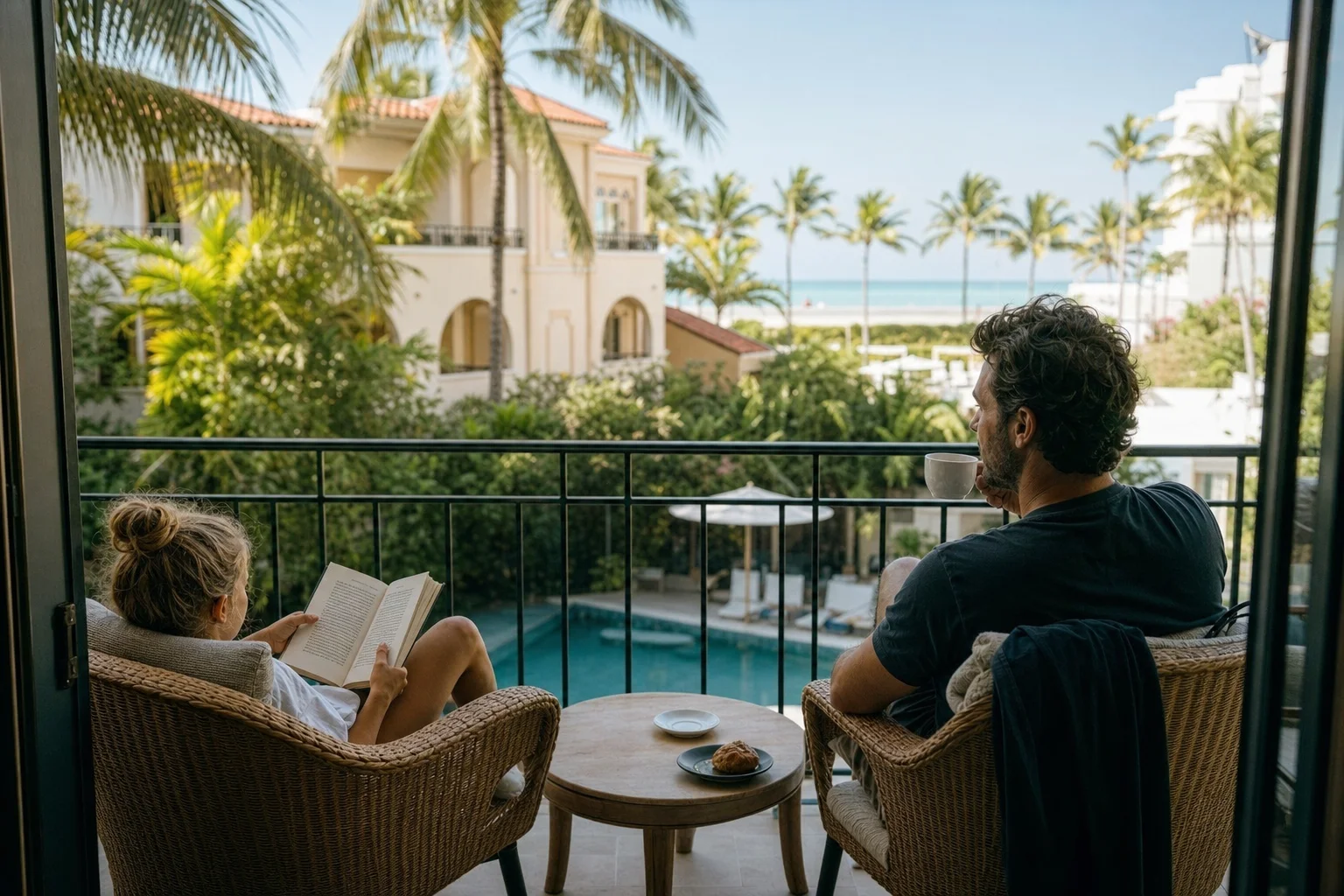
The most family-marketed hotel in South Beach has an autism-specialist certification and reviews that describe its pool as “a zoo with little kids not following any rules.” Both things are accurate, and the gap between them is the thing most families don’t figure out until they’re already there.
Miami is not a naturally low-stimulation city. But it has specific places - a barrier island 10 miles from downtown, a residential beach town north of the club strip, a science museum that dims its planetarium once a month - that can make a calmer trip entirely achievable. The work is almost entirely front-loaded: the right neighborhood, the right property, the right calendar slots. Get those three right and the city mostly cooperates.
How Miami’s geography sorts itself by noise
Stand at Ocean Drive on a Friday evening and you are at peak Miami. Walk six blocks south to South Pointe Park and you are in a shaded neighborhood park with a splash pad, calm water views, and a local crowd that arrives for evening walks. That distance - roughly half a mile - represents roughly half the volume reduction you can achieve.
The full arc runs further. South Pointe Park (the quiet tip of South Beach) → Surfside and Bal Harbour (5 miles north, residential beach towns where the loudest thing on the strip is the wind) → Key Biscayne (an island with one road in, half of its land a state park, the nearest nightclub across a bridge). The further you move along that line from Ocean Drive, the lower the ambient load.
Key Biscayne is the logical end of that arc. TripAdvisor’s Miami family forums say it consistently: “Key Biscayne is much more low key - half of the island is parks.” The Rickenbacker Causeway makes it a deliberate choice - you won’t drift in accidentally - and the island geography keeps foot traffic thin even during peak months.
Key Biscayne or Surfside - the two neighborhoods that solve the noise problem
Ritz-Carlton Key Biscayne
The property reopened December 8, 2025 after a $100 million renovation - its first comprehensive renewal in 25 years. Pre-renovation reviews called the bathrooms “barely large enough for an adult” and the outdoor kids club inoperable in rain. The new layout addresses both: the Ritz Kids Club for ages 5–12 is now indoors, and the dual pool setup separates experiences structurally - a zero-entry family pool with splash pad on one side, a Tranquility Pool for adults on the other.
The main argument for it isn’t the renovation - it’s the island. You wake up already somewhere calm, 15–20 minutes from South Beach via the Rickenbacker Causeway if you want it, with no pull to go.
Four Seasons Hotel at the Surf Club
Surfside, 5 miles north of South Beach. Fewer than 80 rooms, 900 feet of private beachfront, and a residential neighborhood with no nightclub strip. Reviews describe it as feeling nearly private even at capacity: “it never felt that way.” The Kids Club runs for ages 4–12. The property is genuinely premium-tier, so budget accordingly - but the size-to-beachfront ratio is unlike anything else at this level in the Miami area.
Beach Haus Key Biscayne
For families who want Key Biscayne without resort pricing: apartment-style units with full kitchens, a Booking.com score of 9.4, and guest reviews that describe it as “quiet but close to everything - the beach, grocery, state park.” No hotel-scale pool crowd, no managed programming. This is the option if cooking and decompressing matters more than a spa and a concierge.

The three properties above sit at very different price points and have meaningfully different tradeoffs in terms of space, services, and how far they put you from the city’s noise. If you want help figuring out which fits your trip - dates, group size, budget - Mira can walk through it with you.
AI travel agent
The honest note on Loews Miami Beach
Loews holds a Certified Autism Center designation from IBCCES - staff completed sensory-awareness training, which is real. What the designation doesn’t create is a calm physical environment. The hotel’s positioning as South Beach’s premier family property draws a high concentration of families. A May 2024 TripAdvisor reviewer wrote: “The pool was really overrun by kids. They are everywhere and it’s impossible to relax around.” A second review described it as “a zoo with little kids not following any rules.” If Loews is on your shortlist, go in knowing the pool will be chaotic during any school vacation window.
Miami’s sensory programming calendar
Miami surprises here. The city’s most thoughtfully designed low-stimulation infrastructure is not in a hotel - it’s in its cultural institutions. Several named venues run monthly modified sessions with named, bookable accommodations: dimmed exhibits, capped capacity, sensory backpacks at the door.
Frost Science: monthly dimmed-exhibit sessions on the first Saturday
First Saturday of each month, 10–11:30 AM. Specific modifications: dimmed planetarium lights, muted sounds in the Ultimate Dinosaurs exhibit and the Power of Science and MeLab interactive areas, lowered aquarium lighting in The Deep. Sensory backpacks - child and adult sizes - available first-come-first-served at the front kiosk, stocked with noise-reducing headphones and sensory toys. The adult-size backpacks are a detail most venues skip; Frost doesn’t. Standard admission applies; a limited pool of free tickets is available through a Nahmad Foundation request form on their site.
Miami Children’s Museum: free admission, but the RSVP closes Friday at 5 PM
Second Saturday of each month. Admission is free with required RSVP, which closes the Friday before at 5 PM. Capacity is limited, so book early - showing up without an RSVP means being turned away. Accommodations include dimmed lights, lowered sound, capped attendance, a Multi-Sensory/Snoezelen Room with calming visuals, and service providers on-site during the session.
Vizcaya Museum and Gardens
Vizcaya is a 10-acre historic estate in Coconut Grove - more garden path than gallery. Sensory kits are available on request at the Admissions booth (confirmed, though the staff don’t lead with it). The Secret Garden has winding paths and secluded benches. Because the space is mostly outdoors and navigable at the child’s own pace, it works for families who can’t do traditional gallery visits. The open bay-facing scale absorbs noise in a way that a museum interior can’t replicate.
Zoo Miami
Also holds a Certified Autism Center designation from IBCCES. Practical tools available at the gate: sensory backpacks with noise-cancelling headphones, fidget toys, and lap pads. At 750 acres with 4 miles of walkways, the zoo’s physical size means that moving away from a crowded area is always an option - the crowd density stays low because the space is simply very large.
The Frost and Children’s Museum programs both run on specific Saturdays with specific booking requirements. If you’re trying to build an itinerary around them and want to make sure the timing works with your travel dates, Mira can help you map it out.
AI travel agent
The beaches that don’t have waves
Miami’s Atlantic-facing beaches have surf. Its bay-facing beaches don’t - and that distinction matters more than most family travel content acknowledges.
Crandon Park Beach and Bill Baggs Cape Florida State Park are both on Key Biscayne, facing the protected bay, with water shallow and flat enough that children still gaining ocean confidence can spend a full day there. Crandon has a historic carousel and a marine animal sculpture playground; Bill Baggs has picnic pavilions and ranks consistently in national top-10 lists. Neither has a resort DJ, boardwalk hawkers, or a fee structure that requires you to spend money to stay. The geography does the filtering for you.
Matheson Hammock Park in Coral Gables has a man-made atoll pool refreshed by Biscayne Bay - lifeguard-supervised, genuinely calm. The honest tradeoff: water quality is inconsistent, with multiple reviews flagging strong odors and murky conditions. There’s no reliable advance indicator. Check recent visit reports before making it the day’s centerpiece. Same caveat for Crandon: March through May seaweed accumulation has appeared in 2025 reviews.
The calendar windows that change everything
Late April into early May and the September–November window give you the best combination of thin crowds, reasonable water temperature, and hotel rates that aren’t at their peak. July is when Miami locals use the city - the tourist-to-local ratio inverts, and beach mornings before 10 AM have actual breathing room.
Spring break (March through mid-April) and the week between Christmas and New Year are the windows to avoid if crowd predictability is a priority. Art Basel in early December concentrates a different crowd - less family chaos, but Wynwood and the Design District run noticeably louder and more congested than usual.
Frequently Asked Questions
Is Miami too overwhelming for a child who gets easily overstimulated?
Does Loews Miami Beach actually deliver on its Certified Autism Center designation?
What is the Frost Science 'Just for Me' program and how do I get in?
Are there beaches in Miami where kids can swim without big waves?
When is the least crowded time to visit Miami with children?
More articles about Miami
Destination Guide
-

Miami Family Vacation (2026): What Actually Works
Most families book the wrong neighborhood, skip the Everglades, and don't find out what Miami actually costs until they check out.
-

First-Timer's Guide to Miami with Kids
The neighborhood you choose will determine almost everything else about your trip.
Who's Traveling
-

Miami with Large Families: Suites, Rentals, and Real Costs
The suite-vs-rental math, the resort fee reality, and the neighborhoods South Beach loyalists don't mention.
-

Multi-Generational Miami: What Actually Works
Three generations, two pool areas, one trip where nobody has to apologize for needing a rest.
-

Miami with a Baby: Where You Stay Is the Whole Trip
The neighborhood you book determines more than the hotel you book - here's how to read the map.
-

Miami with Grandparents
The city has real infrastructure for slow travel - free beach wheelchairs, step-free trolleys, a 7-mile coastal path - but it only pays off if you choose the right half of it.
-

Miami with School-Age Kids: What Actually Works
The city has no single family zone. Where you base yourself determines whether this trip works.
-

Miami with Teens
The city that works better than a theme park - if you stop trying to run it like one.
-

Miami with a Toddler: What Actually Works
The party-beach reputation misleads a lot of parents. The city is more workable than that - if you pick the right pocket of it.
Sensory & Accessibility
-

Miami for Families Who Need a Quiet Base
The certified infrastructure here is real, and more extensive than most families realize - but it only works if you start with the right neighborhood.
-

Quiet Hotels in Miami: Where to Actually Sleep
The noise in Miami is a geography problem. Pick the right neighborhood and the hotel choices follow.
-

Sensory-Friendly Miami: Beaches, Programs & Hotels
Florida's most structured city for low-stimulation travel - if you know which 4 miles of beach to avoid.
-

Wheelchair-Accessible Miami: Beach Access & What to Verify
The beach access infrastructure is genuinely impressive. The sidewalks and the Metromover are not.
Food
-

Miami for Families with Dietary Restrictions
The culinary diversity here is structural, not cosmetic - it changes the math on where your family can actually eat.
-

Miami with Food Allergies
The city's cuisine identity - stone crab, ceviche, shared fryers - makes preparation non-optional.
-

Miami with a Picky Eater
The real challenge isn't finding plain food - it's knowing where not to eat.
Room Setup
-

Miami Connecting Rooms: Who Actually Guarantees It
The difference between a request and a guarantee - and the handful of Miami hotels that have actually solved it.
-

Miami Family Suites With Real Separation (and Real Kitchens)
"Suite" is one of the most abused words in Miami hotel marketing. Here's what to ask for - and where to find it.
-
Miami Hotels with Kitchenettes & Full Kitchens
Miami's dining costs make the kitchenette decision more consequential than almost anywhere else in the country - but "kitchenette" on Miami listings often means a mini-fridge and a microwave.
On-Site Activities
-

Miami Hotels with Kids Clubs: Who Actually Has One
Six hotels in Miami run genuine supervised drop-off programs. Several famous names no longer make the cut.
-

Miami Hotel with Lazy River: The Honest Answer
The aggregator lists are wrong. Here's what the Miami area actually has - and the one property worth booking.
-

Miami Water Parks
The honest answer is different from the one most travel sites give you - and knowing it saves a disappointing afternoon.
Powered by Mira
Tell Mira about your family
Two minutes of conversation. A shortlist of hotels that actually fit — connecting rooms, accessible layouts, calm floors, whatever your family needs.
AI travel agent · free to try
Talk to Mira Let Mira find the right hotels for your family. Find hotels with Mira
AI travel agent · free to try