
Florida
Fort Lauderdale for first-time visitors
The four decisions - which beach, which base, which season, which way to get around - that quietly make or break your first trip.
AI travel agent · free to try
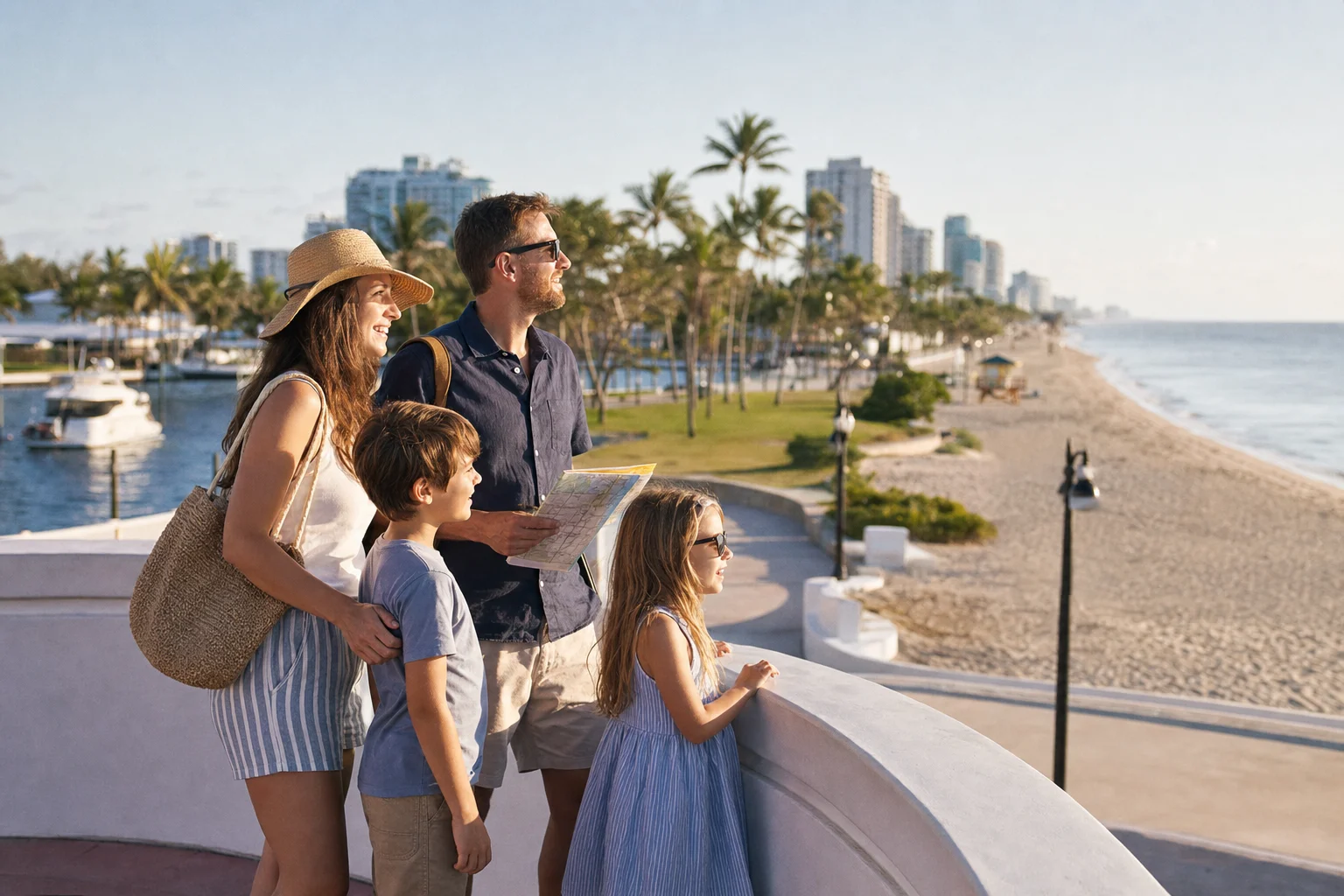
The thing first-time visitors get wrong about Fort Lauderdale is treating “the beach” as one place. It’s seven miles of barrier-island coast, and the few blocks around Las Olas and Seabreeze - the postcard stretch with the wave wall - is the busy, bar-leaning piece. The family-leaning city beach is north of Sunrise Blvd; the calmest stretches are out of the city limits entirely, in Lauderdale-by-the-Sea ten minutes north or Hollywood Beach ten minutes south. Book the wrong one in March and you’ll wonder why everyone said this place was relaxed.
The good news is the rest of the trip is more navigable than the brochures admit. Fort Lauderdale has more navigable canals than Venice, Italy - “Venice of America” is a literal claim - and the Water Taxi treats them like a transit line. The Brightline gets you to Miami or West Palm Beach in about half an hour, hourly, sixteen trains a day. If you base downtown, you can do a full week here without a rental car.
What kind of trip this actually is
A beach trip with canals threaded through it, half an hour from the Everglades, an hour from Miami by train. Outside a few specific downtown blocks it isn’t a theme-park or nightlife city. The honest self-selection question before you book: do you want a busy beachfront vacation, a walkable downtown stay with day trips, or a quiet pier-village week in a smaller adjacent town? Each is genuinely available here, and the answer determines the neighborhood, whether you need a car, and what your evenings look like.
Where to stay - and why the geography matters
Four picks, each for a different kind of reader.
Fort Lauderdale Beach, north of Sunrise
The classic first-timer choice and the right one if the beach is the whole point. You’re on the wave-wall promenade with direct sand access and oceanfront restaurants. Lago Mar Beach Resort & Club is the quiet hero of the parent-review corpus - family-owned, on a private stretch at the south end, and notable for having no resort fee while most of its neighbors stack $30-$45 a night on top of rack rate. Fort Lauderdale Marriott Harbor Beach sits on a private quarter-mile of sand with a kids’ Surf Club; premium-priced and full-service. Hilton Fort Lauderdale Beach Resort and Conrad Fort Lauderdale Beach are the conference-tier and luxury-tier alternatives on the same strip.
Las Olas and downtown
The fastest-changing part of the city - downtown tourism was up 18% in overnight visitors since 2023, with Las Olas foot traffic up 5% year over year in spring 2025. You’re walkable to the Riverwalk, Las Olas dining, the Brightline station, and Water Taxi Stop 1 at the Riverside Hotel garage. The beach is about two miles east; the Sun Trolley Las Olas Link bridges it. Names that come up: the Riverside Hotel itself, Hyatt Centric Las Olas, Dalmar (Tribute Portfolio), Fairfield Marriott Las Olas. Pick this base if you want walkable evenings and intend to day-trip Miami or West Palm.
Lauderdale-by-the-Sea or Hollywood Beach
Both are about ten minutes outside the city and trade the postcard wave wall for calmer crowds and better value. LBTS is a small pier-village with a shore-accessible coral reef about 100 yards off the sand. Hollywood has a 2.5-mile paved beachfront Broadwalk past shops, bike rentals, and casual seafood. Older buildings, lower nightly rates. If you wanted “the beach” without “the strip,” this is what you actually wanted.
17th Street Causeway
The pre-cruise corridor. Embassy Suites 17th Street, Hilton Fort Lauderdale Marina, and Hyatt Place Airport South & Cruise Port are five minutes from Port Everglades and FLL. The strip itself is functional rather than scenic; book here only if you’re sleeping a night before a ship. One trap: several hotels advertise a “free cruise shuttle” that runs once at a fixed early-morning departure or hands off to a third-party van. For a five-minute hop, the Uber is often faster.

Tell Mira whether the trip is anchored to the beach, the downtown walk-and-train life, or a pre-cruise overnight. She’ll match you to the specific hotel - Lago Mar, the Hyatt Centric, Embassy Suites - that fits how you actually travel, with the resort fee and the actual distance to the port spelled out instead of buried.
AI travel agent
When to go
Visit Lauderdale points at October and May as the sweet spots, and the official line tracks what the weather actually does - warm, dry, no spring-break overlap, prices nowhere near peak.
December through April is the peak window: high-70s days, low rain, dependable conditions, and rates to match. Reservations tighten approaching Presidents’ Day weekend and stay tight through Easter.
June through September is hot and cheap. Heat index commonly runs 100°F+, thunderstorms hit most afternoons between two and five, and Atlantic hurricane season runs June 1 through November 30 with August and September the highest-risk weeks. Locals run beach-morning, indoor-afternoon. A summer trip needs a named indoor anchor for each afternoon - MODS downtown, Xtreme Action Park, the Galleria mall, or a Brightline day trip to Miami - and travel insurance with named-storm coverage is worth pricing in.
The spring-break window deserves its own line. Fort Lauderdale’s 1980s reputation is genuinely outdated, but the geography it lived in is small and well-defined: the city’s High Impact Zone along the barrier island around Las Olas Blvd is regulated heavily roughly February 28 through April 13, with a 10pm-5am curfew for under-18s without a parent, no alcohol or coolers on the beach, bars stopping alcohol service at 2am, and the beach closing at 5:30pm on peak days. Outside that window and that zone, the city is family-leaning year-round.
Getting around
It depends on where you sleep, and most first-timers default to “rent a car” without realizing they’ve made the wrong call.
If you base downtown or on Las Olas, you can do the trip without a car. The Brightline runs 16 daily round trips from the downtown station - hourly to Miami in about half an hour, the same to West Palm Beach, three hours up to Orlando. The Water Taxi runs 10am to 10pm daily with boats every 35-45 minutes across 11 stops on the Intracoastal and the New River; an all-day pass is the single best first-day move in the city. The Sun Trolley adds free or low-cost hop-on/hop-off service on seven routes, including a Las Olas Link bridging downtown to the beach. Uber fills the gaps.
Base on the beach and want to see anything beyond walking distance - Everglades half-hour west, Butterfly World north, Hollywood south, Las Olas - the rideshare bill adds up faster than a rental. Rent the car.
FLL to a beach hotel is a 15-minute drive. The airport itself is in the top 25 busiest in the country and runs longer-than-average security lines, especially on cruise turnaround Saturdays - build in airport time on the way home.
A first-trip shape that works
Not a 1-2-3 itinerary; a shape that respects how the city actually moves.
Day one is the Water Taxi loop. Pick up the all-day pass at Stop 1 (the Riverside Hotel garage downtown), ride the full circuit once for the narrated canal-and-mansion tour, then hop off at Las Olas for dinner. Sit upstairs on the open deck for the loop. The 15th Street Fisheries stop is the one where you feed the tarpon off the dock.
Day two is the beach morning. North of Sunrise on the city beach, or up at LBTS where the reef is snorkelable from the sand, or down at Hollywood where the Broadwalk gives you something to bike if the sun gets relentless. Hugh Taylor Birch State Park - 180 acres between A1A and the Intracoastal - has a tunnel under A1A to the beach and rents bikes, kayaks, and segways on the inland side. Cheap, quiet, walkable from the beachfront hotels.
Day three is the Everglades half-day. Everglades Holiday Park is 30 minutes west; the airboat tours run an hour, narrated, no minimum age. Pair it with Bonnet House Museum & Gardens on the way back - a 1920s estate on 35 acres between the beach and the Intracoastal, the kind of place a returning visitor describes as “a palatial home with funky decor and incredible grounds.”
If you have a fourth day and based downtown, that’s your Brightline day. Miami’s Wynwood walls and South Beach in 30 minutes, or West Palm and the Norton Museum the other direction in the same. Either beats driving I-95.
Mira can sequence the Water Taxi loop, an Everglades morning, and a Brightline day trip against your actual hotel and travel dates - and tell you whether the weather window you booked makes the beach mornings or the indoor anchors the better default.
AI travel agent
Two things locals actually care about at the beach
Rip currents are the real risk here. South Florida lifeguards pulled more than 70 swimmers from rip currents in a single weekend in 2024 - the shark stories travel further, but the currents are what the lifeguards spend the day on. Florida’s standardized flag program runs double red (water closed), single red (high hazard), yellow (medium), green (low), purple (dangerous marine life). Swim near a lifeguarded stand; daily conditions are posted at fortlauderdale.gov/visitors/beach-conditions.
Sargassum is the May-through-August surprise. Brown seaweed blooms have been arriving earlier and heavier in recent years - 2025’s Memorial Day weekend saw significant piles on South Florida beaches - and tiny creatures living in the seaweed can cause skin rashes. It clears and returns in patches, so it’s worth knowing your beach week might smell faintly of rotting eggs and the lifeguards will tell you which stretch is currently cleaner.
One last cost calibration. Almost every beachfront hotel adds a $30-$45/night resort fee the booking sites bury. Compare the all-in nightly when you shop - the headline rate hides the gap. Lago Mar’s no-resort-fee status is genuinely unusual here and a real part of why it shows up so often in parent reviews, before you ever get to the “watch kids from the restaurant table” geometry that makes the property work.
Frequently Asked Questions
Is Fort Lauderdale or Miami better for a first trip to South Florida?
Where should first-time visitors stay in Fort Lauderdale?
What is the best time of year to visit Fort Lauderdale?
Do I need a car in Fort Lauderdale?
How far is Fort Lauderdale Airport from the cruise port?
More articles about Fort Lauderdale

Who's Traveling
-

Fort Lauderdale with Large Families: Suites and Rentals
Calmer beaches, canal-neighborhood rentals, and the suite math that decides whether the trip works.
-

Multi-Generational Fort Lauderdale: What Actually Works
Three generations, one beach, and no requirement that anyone keep up with anyone else.
-

Fort Lauderdale with a Baby: The Gear Question Comes First
The hotel either gives you the gear or you rent it from a service that meets you at the airport - those are the two real choices.
-

Fort Lauderdale with Grandparents
Calmer than Miami, compact enough that nobody gets exhausted, and quietly equipped for mixed-mobility groups - if you know which water taxi to skip.
-

Fort Lauderdale with School-Age Kids: What to Book
A beach-first trip with an unusually deep bench for 6- to 14-year-olds - if you book around the weather and skip the wrong week in March.
-

Fort Lauderdale with Teens
A beach base with a credible activity menu - if you plan it before you land.
-

Fort Lauderdale with a Toddler
The A1A question, the right beach base, and the indoor backups that save the midday meltdown.
Sensory & Accessibility
-

Sensory-Friendly Fort Lauderdale: A Planning Guide
The destination doesn't carry a single certification - it carries a deep bench of individual programs, and the trip works when you stitch them together yourself.
-

Low-Stimulation Fort Lauderdale: Calm Beaches and Stays
A parallel, calmer geography sits a few blocks from the A1A strip - state-park beach access, a walled-garden estate, and mangrove boardwalks do most of the work.
-

Quiet Stays in Fort Lauderdale: A Geography Problem
The quietest hotels in the metro sit on a private peninsula or three miles north of the strip, where the geography does the work no window can.
-

Sensory-Friendly Fort Lauderdale, Without the Strip
Stay off the Strip, plan around the scheduled sensory calendar, and the metro turns into a different city.
-

Wheelchair-Accessible Fort Lauderdale: Beach & Beyond
A beach trip whose accessibility is real, seasonal, and dependent on a few calls most planning guides never mention.
Food
-

Fort Lauderdale with Food Allergies: What Actually Holds
Two dedicated kitchens, one chain-grade top-9 protocol, and a 17th Street corridor that quietly solves the pre-cruise problem.
-

Fort Lauderdale Dietary Accommodations: 2026 Reset
Four anchor restaurants closed in 2025. The honest map is shorter, and the working playbook is different.
-

Fort Lauderdale with Picky Eaters: Where Kids Actually Eat
The chicken-tender map of Broward - hotel restaurants, 24-hour diners, and the chain backup that's always ten minutes from the beach.
Room Setup
-

Fort Lauderdale Connecting Rooms: What Actually Books
Which Fort Lauderdale-area hotels actually pre-confirm connecting pairs, and why a two-room suite often beats the chase.
-

Fort Lauderdale Suites for Families: What Actually Fits
The hotels where parents close a door, kids take the sofa bed, and four to six people sleep without a cot.
-

Fort Lauderdale Hotels With Kitchenettes (That Cook)
Three tiers of kitchen, two reliable cook-a-meal options on the sand, and the grocery delivery that finally makes the math work.
On-Site Activities
-

Fort Lauderdale Kids' Clubs: What You're Actually Booking
An ocean day camp, a poolside craft hour, and a true drop-off room all share the name. They are not the same thing.
-

Fort Lauderdale Hotels With a Lazy River
One hotel in town has a lazy river, and it's the size of a hot tub - the rest of the answer lives a short drive south.
-

Fort Lauderdale with a Water Park
The city doesn't have one. Three tiers of substitutes do - if you book the right month.
Powered by Mira
Tell Mira about your family
Two minutes of conversation. A shortlist of hotels that actually fit — connecting rooms, accessible layouts, calm floors, whatever your family needs.
AI travel agent · free to try
Talk to Mira Let Mira find the right hotels for your family. Find hotels with Mira
AI travel agent · free to try