
Florida
Planning an Orlando Trip Around Sensory Needs
The infrastructure here is real - but one major access program is in active legal dispute, and most planning guides haven't caught up.
AI travel agent · free to try
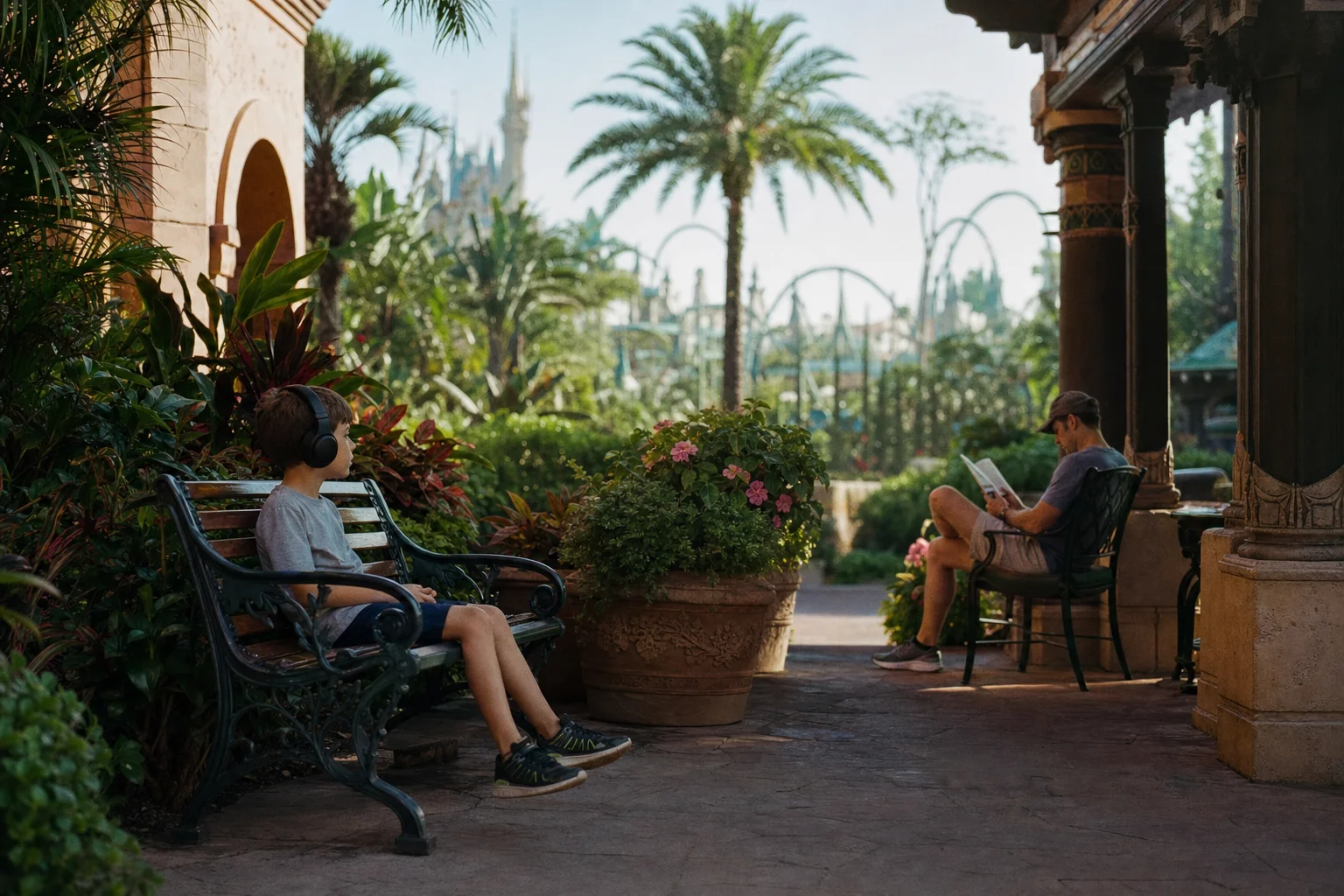
The trip starts before you clear Customs. Orlando International Airport became an IBCCES Certified Autism Center in April 2024. It operates Annie’s Space - a Snoezelen® Multi-Sensory Environment in Terminal A, Level 3, open 7am to 9pm, free: glowing moon rocks, a Milky Way-themed carpet, bubble tubes, tactile panels. Free Hidden Disabilities Sunflower lanyards at the Level 3 information desk signal to trained staff that your family may need more time or help, without anyone having to explain why.
That’s the honest version of what Orlando offers in 2026: real infrastructure, built deliberately, across dozens of venues. But there’s a gap in the middle of it that matters before you book anything - Disney’s Disability Access Service is under active investigation by the Florida Commission on Human Relations (FCHR No. 2026119734, advanced to investigation in April 2026 after mediation failed). A separate class-action lawsuit was filed in 2025. This is live, and most of what’s written about DAS dates from before the policy overhaul of May 2024 that triggered the complaints.
What the SeaWorld cluster actually offers
The most coherent end-to-end trip in Orlando isn’t at Disney or Universal. It’s at the cluster of SeaWorld Entertainment parks and hotels on International Drive South.
SeaWorld Orlando, Aquatica, and Discovery Cove are all IBCCES Certified Autism Centers. Three adjacent hotels - DoubleTree by Hilton Orlando at SeaWorld, SpringHill Suites by Marriott at SeaWorld, and Fairfield Inn & Suites by Marriott at SeaWorld - are also CAC-certified. The cluster model matters: consistent staff training language, consistent sensory guide format, and a mid-day retreat that’s five minutes away rather than 45.
SeaWorld has two quiet rooms (first-come, first-served): one near the Information and Reservations Counter, one inside the Childcare Facility in Sesame Street Land. A low-stimulation zone sits between Dolphin Cove and the SeaWorld Rescue Center.
Discovery Cove is structurally different from anything else in Orlando - and it’s worth understanding why. Daily attendance is capped at roughly 1,000 to 1,300 guests. Admission is all-inclusive: food, drinks, wetsuit rental. There are no standard queues. An IBCCES Sensory Guide rates every animal encounter and attraction. The quiet space near First Aid has seating and adjustable lighting. Private rental cabanas exist for additional separation.
This model wasn’t designed as a sensory accommodation. It was designed as a premium product. But it eliminates almost every decision point that makes other park days hard: no mid-day food purchase negotiations, no queue geometry, no crowd thresholds. One specialist travel advisor who works with this audience put it plainly: “Nothing is required. Children can observe the dolphin swim, participate partially, or skip entirely.”
The tradeoff is real. Discovery Cove’s dolphin swimming and animal encounters have safety requirements that some guests won’t be able to meet. Families with children who have unpredictable water reactions should review those requirements before booking.

Discovery Cove’s attendance cap means it books out months ahead in peak season. Tell Mira your dates and she’ll check current availability and whether the quiet-space cabanas are still open.
AI travel agent
Disney’s DAS: what the process is now
Disney’s Disability Access Service still exists, but the process changed in May 2024 and is now under active legal scrutiny - which means much of what’s written about DAS predates how it actually works.
Pre-registration requires a video call up to 60 days before arrival. The person with the disability must be present and visible on camera - for non-verbal or minimally verbal children, that’s a real procedural barrier. Cast Members assess functional need in real time. DAS returns a time matching the current standby wait; guests wait that same duration elsewhere rather than in the queue, covering up to three companions.
Approval has been inconsistent. Parent reports include denials for guests with documented diagnoses, with outcomes varying by who conducts the interview. One parent described her grandson with autism being told he “wasn’t disabled enough.” If DAS is denied, Disney offers Return to Queue, Rider Switch, and paid Lightning Lane. Disney’s cognitive disability guides for all four parks - per-attraction ratings across scent, lighting, noise, darkness, duration, and startle moments - are available through Disability Services regardless of DAS status.
Two planning notes that hold regardless of where the legal situation lands: Epcot and Animal Kingdom run quieter than Magic Kingdom, with more outdoor space and a calmer attraction set. Disney resort buses can overwhelm - multiple parents describe the first meltdown of a Disney trip happening on a resort bus. Uber or Lyft removes that variable.
Universal Orlando, including Epic Universe
Universal’s Attraction Assistance Pass shifted in late 2025. The old virtual return-time system has largely been replaced by Return to Queue (leave the line, come back later) and Line Meet-Up. Families apply at Guest Relations on arrival; no pre-registration. The IBCCES Individual Accessibility Card is optional but speeds the process. Quiet rooms at each park have dimmable lighting, weighted blankets, and sensory wall toys, with a 30-minute limit that can be extended.
For families who find the AAP process itself stressful: Premier hotels include complimentary Universal Express, which covers most attractions and removes the need to apply at Guest Relations at all.
Epic Universe (opened May 2025) has a quiet room between Helios and Ministry of Magic. Isle of Berk has wide walkways and manageable soundscapes; Dark Universe cycles near-constant sound and electrical pulse effects every 15 minutes and is the most intense land in the park. A parent at Epic Universe in 2025 reported her son wearing hearing protection in Dark Universe and a team member proactively offering a quiet dragon hatching ceremony at Isle of Berk after noticing - suggesting the staff culture at Epic Universe may be ahead of Universal’s formal policy language.
If you’re deciding between the SeaWorld cluster, Disney, and Universal - or trying to figure out which combination makes sense for your specific trip - Mira can help map out the parks against your priorities without the generic “all three are great” answer.
AI travel agent
Beyond the big parks
Some of the strongest certified infrastructure sits outside the Disney-Universal conversation.
Kennedy Space Center became an IBCCES Certified Autism Center in July 2023. Four low-sensory break areas are distributed through the complex; their specific locations are in the KSC sensory guide (available on the KSC app or at Guest Services). Sensory signage rates each attraction 1–10. Noise-cancelling headphone rentals available.
LEGOLAND Florida (Winter Haven, 45 minutes from Orlando) is the first full resort in North America with IBCCES CAC designation: all parks and all three hotels certified. Lower ride intensities, smaller crowds, three in-park sensory rooms, and 1–10 sensory ratings per attraction. One TripAdvisor parent called out “more rides to choose from” and fewer bottlenecks compared to the major parks. It works best as a standalone destination - 45 minutes from International Drive makes it a separate trip.
Crayola Experience runs Sensory Sundays on five 2026 dates (Feb 22, Apr 19, Aug 16, Oct 4, Dec 6), 10am–noon: lights dimmed, sound effects off, quiet room open, UCF CARD on-site. Calendar them before planning around them.
Dr. Phillips Center for the Performing Arts holds one of only two IBCCES CAC designations at a US performing arts center: social stories, complimentary fidget toys, noise-cancelling headphones, and quiet rooms at both venues.
The trip structure that doesn’t fall apart at 2pm
Multiple parents across different venues say the same thing: flexibility is the actual planning target. One parent who has done three Disney trips with her daughter - at ages 7, 12, and 17 - skipped a paid show because “Brie was done long before show time.” The schedule is the tool; it’s not the point.
What that looks like practically: knowing your exit plan before you need it. A hotel five minutes from the park entrance. A private base - VillaKey’s Orlando portfolio covers 100+ properties with dimmer switches, fenced pools, door-chime safety systems, fragrance-free cleaning, and full kitchens. They’re the only IBCCES Certified Autism Center vacation rental operator in the world, and a kitchen removes a category of daily decisions that compound across a week.
The parent who did two years of practice runs at UK parks and Disneyland Paris before Disney World was direct: “Practice runs aren’t overkill, they’re necessary.” Orlando is large in a way that only becomes real inside it. Starting with Annie’s Space at MCO is that - the airport tells you whether the infrastructure matches the marketing before you commit to the first park day.
Frequently Asked Questions
Does Disney still offer DAS for children who can't wait in a standard queue?
What does an IBCCES Certified Autism Center designation actually mean?
What's the calmest park option if standard theme park crowds are too much?
Does Orlando International Airport have anything to ease arrival?
Is Universal's Attraction Assistance Pass the same as Disney's DAS?
Are there vacation rentals in Orlando set up for sensory needs?
More articles about Orlando
Destination Guide
-
Orlando Family Vacation Guide (2026)
Most families compare nightly rates when they should be comparing perk buckets - and that one mistake shapes everything else.
-

First-Timer's Guide to Orlando (2026)
Every guide written before May 2025 is now out of date. Here's what planning actually looks like today.
Who's Traveling
-

Orlando for Large Families: What to Know First
Eight people, one plan - get the sleeping situation right and the parks take care of themselves.
-

Multi-Generational Orlando: What Actually Works
Three generations, three different energy clocks - here's how to keep everyone in the trip.
-
Orlando with a Baby
The trip works when the baby's nap schedule runs it, full stop.
-

Orlando with Grandparents: What Actually Works
The infrastructure is built for this - but the planning margin for error is lower than most families expect.
-

Orlando with School-Age Kids (Ages 6–12)
Ages 6–12 are the golden window. Here's how not to waste it.
-

Orlando with a Toddler
The hotel that gets you back to a bed in under 20 minutes is worth more than any amenity list.
-
Orlando with Teens
The parks worth your days, the ones worth skipping, and the hotel trick that gives teenagers actual independence.
Sensory & Accessibility
-
Orlando Low-Stimulation Travel
Calm and Orlando aren't mutually exclusive - but you have to build the trip around it deliberately.
-
Quiet Hotels in Orlando That Actually Deliver
Price and brand tell you almost nothing about how well you'll sleep - the geometry of your room does.
-

Sensory-Friendly Orlando: What's Actually Built
The most documented city in the US for sensory-aware travel - and the one park where the gap between promise and reality is widest.
-
Wheelchair-Accessible Orlando: What Actually Works
The infrastructure is genuinely good. The booking language is not.
Food
-

Dietary Accommodations in Orlando Theme Parks
The infrastructure is genuinely good. The process changed in February 2026, and most families haven't caught up yet.
-

Food Allergies at Orlando Theme Parks
The landscape just shifted - and the park with the better allergy process is not the one you'd expect.
-

Orlando with a Picky Eater
The parks are more manageable than parents expect - but only if you do one thing before you arrive.
Room Setup
-

Orlando Connecting Rooms: Who Actually Guarantees It
The difference between a request and a guarantee - and which hotels in Orlando have actually solved this.
-
Family Suites in Orlando
The word "suite" means something different at every Orlando hotel - knowing the difference before you book saves the trip.
-

Orlando Hotels with Kitchenettes & Full Kitchens
The word "kitchenette" hides a spectrum - from paper plates and a microwave to a full oven you can actually cook Thanksgiving in.
On-Site Activities
-

Orlando Hotel Kids Clubs That Actually Do Drop-Off
Real childcare, not a room with crayons and a sign.
-

Best Lazy River Hotels in Orlando (and One Big Myth)
The most searched lazy river in Orlando is also the most disappointing - the good ones are somewhere else entirely.
-

Orlando Water Parks
Every family picks the wrong one at least once. Here's how to pick the right one first.
Powered by Mira
Tell Mira about your family
Two minutes of conversation. A shortlist of hotels that actually fit — connecting rooms, accessible layouts, calm floors, whatever your family needs.
AI travel agent · free to try
Talk to Mira Let Mira find the right hotels for your family. Find hotels with Mira
AI travel agent · free to try